


Abstract
Objective: To evaluate the mid-term results of three different surgical techniques utilized for the treatment of femoro-acetabular impingement, by means of functional outcomes and joint awareness.
Materials and Methods: 53 patients were selected retrospectively, treated by one of the three surgical techniques: hip arthroscopy (HA), anterolateral mini open (AMO) or surgical hip dislocation (SHD). Patients with <12 months of follow-up were excluded. Median follow-up period was 57.5 months (range 16-256 months). Primary outcome measures were the Forgotten Joint Score (FJS), Harris Hip Score (HHS) and UCLA activity index. Surgical success was determined as FJS≥70 and a regression analysis was performed on different radiological and clinical parameters for the risk of failure.
Results: Mean post-operative FJS was 74.5 (±13.8) for the HA group, 72.6 (±17) for the AMO group and 52.7 (±24) for the SHD group (p=0.023). Pre-operative and post-operative HHS and UCLA were similar. Post-operative alpha angles were similar (p=0.597). Regression analysis results showed two factors affecting surgical success: pre-operative Tönnis stage (adjusted OR±95% CI: 0.091±0.005-0.659 ; p=0.023) and type of surgery performed (HA: adjusted OR±95% CI: 11.2±1.2-50.5, p=0.029; for AMO: adjusted OR±95% CI: 7.2 ±1.1-48.8, p=0.041).
Conclusion: Despite allowing more complete assessment of the hip joint, SHD results in inferior outcomes when evaluated with FJS.Three surgical approaches provide similar radiological and functional results if evaluated with conventional outcome scores of HHS and UCLA.
Keywords: femoroacetabular impingement, hip joint, cam, hip preservation, forgotten joint score
Introduction
Cam-type femoro-acetabular impingement (FAI) occurs due to the structural deformity of the hip joint and is one of the most common causes of hip pain in young active patients [1,2]. If left untreated, it causes osteoarthritis and hip joint dysfunction in early period with accompanying cartilage and labral pathologies, leading to a decrease in the quality of life[3]. The main purpose of preventive hip surgeries applied in cam-type FAI is correction of the bony deformity, prevention of impingement and treatment of accompanying intra-articular pathologies and improve the quality of daily life. Yet, there is still some debate on the surgical methods for the treatment of this pathology. The safe surgical dislocation defined by Ganz et al.[4] in 2001 was previously described as the gold standard, and the short- to mid-term results for this procedure are also favourable for many authors. However, Hip arthroscopy (HA) and anterolateral mini open (AMO) techniques are more preferred today because surgical hip dislocation (SHD) is a technically challenging procedure which requires ligamentum teres detachment, trochanteric osteotomy and refixation, and is more prone to intraarticular adhesions.
HA and AMO can be applied without the need of trochanteric osteotomy and sacrificing of the ligamentum teres, compared to surgical dislocation, also provide faster rehabilitation and recovery[5,6]. Although these procedures are less traumatic and have low complication rates, there are several associated drawbacks such as risk of femoral nerve palsy, inability to display entire labral or chondral lesion and the difficulty of performing osteoplasty at an appropriate amount.
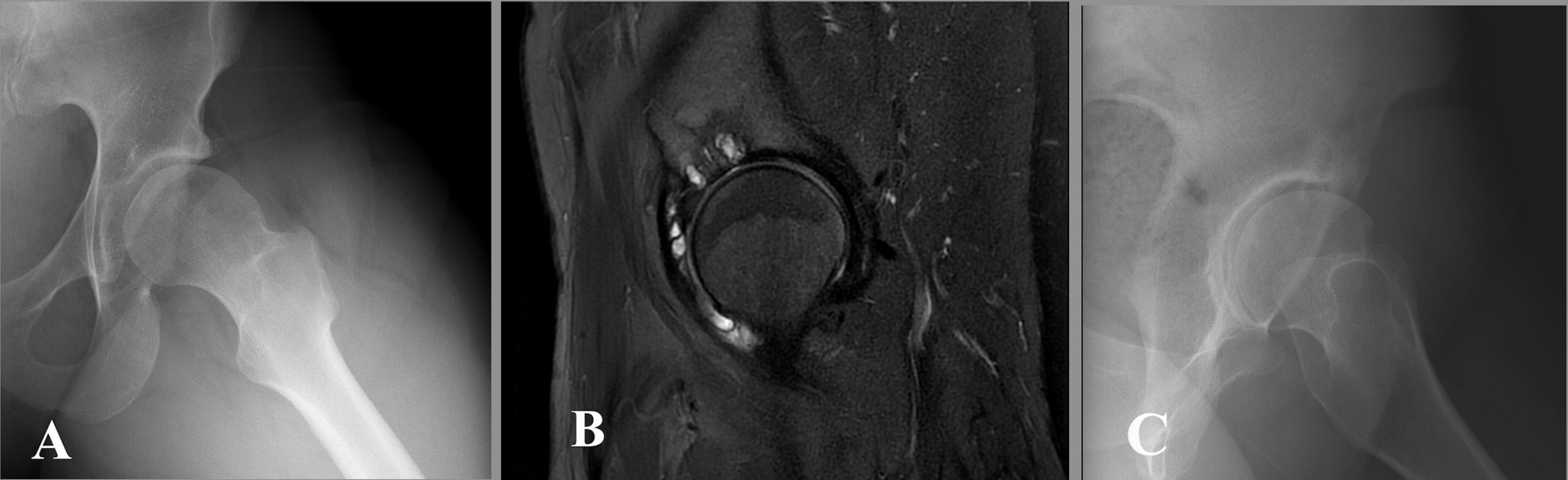
Despite the existence of significant overlap of their indications, there are few studies comparing the results of these 3 surgical methods in the literature[7,8]. Although surgical dislocation was the most preferred method in our clinic in the past, in recent years HA and AMO (Figure 1) approaches have been preferred regarding shorter rehabilitation period and avoidance of implant removal. Besides, SHD is still preferred in patients presenting with global pincer and reserved for the cases that require close evaluation and manipulation of the posterior part of the hip joint.
Functional outcomes of FAI surgery were generally evaluated in the literature with clinical scoring systems such as the HSS and UCLA activity index. These scores mainly focus on the functional status and give less information about patient satisfaction.
The aim of the study is to analyse the midterm results of 3 different surgical approaches by evaluating patient satisfaction and joint awareness with a current patient reported outcome measure (PROM): Forgotten Joint Score (FJS-12).
Our hypotheses are;
- All procedures have similar functional and radiological success without demonstrating a superiority of either technique
- Minimally invasive procedures (HA and AMO) provides higher scores in FJS-12 than SHD
- Pre-operative radiographic or clinical parameters indicating advanced disease adversely affect patient outcome.
Materials and methods
Patients and study design
A single-center consecutive case study is conducted retrospectively at the Hacettepe University Hospital, Department of Orthopaedics and Traumatology.. Approval from the institutional ethical committee has been obtained. Informed consent was obtained from all patients prior to surgery. Institutional database search revealed 53 patients undergoing surgical treatment for FAI between January 1999- January 2019. Patients with <12 months of follow-up were excluded. After exclusion, 41 patients: 24 men and 17 women, with an average age of 35.8 (range 16-62) have been included in our study. The median follow-up period was 57.5 months (range 16-256 months). For further analysis, the patients are separated into three groups according to the surgical method used: HA (n=14), AMO (n=18), and SHD (n=9). The demographic and clinical information of the groups are detailed in Table 1.
| Table 1. Demographic information, clinical parameters and functional status of the three study groups | ||||
|
|
|
|
|
|
| Number of patients |
|
|
|
|
| Age (Mean±SD) |
|
|
|
|
| Sex (Male/Female) |
|
|
|
|
| Body mass index (Mean±SD) |
|
|
|
|
| Pre-operative alpha angle (Mean±SD) |
|
|
|
|
| Follow-up period (Months; mean±SD) |
|
|
|
|
| Tönnis stage |
|
|||
| <2 |
|
|
|
|
| ≥2 |
|
|
|
|
| Anterior offset (Mean±SD) |
|
|
|
|
| Lateral center-edge angle (Mean±SD) |
|
|
|
|
| Acetabular angle (Mean±SD) |
|
|
|
|
| Tönnis angle (Mean±SD) |
|
|
|
|
| Labral tear |
|
|||
| Not present (Full thickness or degenerative) |
|
|
|
|
| Present |
|
|
|
|
| Pre-operative HHS (Mean±SD) |
|
|
|
|
| Post-operative HHS (Mean±SD) |
|
|
|
|
| Pre-operative UCLA (Mean±SD) |
|
|
|
|
| Post-operative UCLA (Mean±SD) |
|
|
|
|
| Post-operative alpha angle (Mean±SD) |
|
|
|
|
| Post-operative FJS (Mean±SD) |
|
|
|
|
| Surgical success according to FJS |
|
|||
| Successful (≥70) |
|
|
|
|
| Unsuccessful (<70) |
|
|
|
|
Treatment
Before the surgical intervention, all patients underwent a thorough physical examination focused for hip impingement. Standard anteroposterior (AP), cross-table lateral and 45o Dunn radiographs[9], and magnetic resonance imaging (MRI) were also obtained. The alpha angle was measured on the 45o Dunn view by two of the authors (RMC, SB) Femoral head-neck offset, lateral center-edge angle (LCEA) , acetabular angle of Sharp[10] and the Tönnis angle were also measured. The extent of degeneration was evaluated according to the Tönnis classification[11]. For further analysis, the Tönnis stage was dichotomized as <2 and ≥2. MRI was examined for labral tears. As for functional assessment, each patient is asked to complete the Harris Hip Score[12] (HHS) and the UCLA activity scale [13].
Same surgical team (OAA, BA) performed all the procedures. Hip arthroscopy was performed with the patient in supine position, on a traction table. Most commonly used portals were anterior, anterolateral and posterolateral. Anterolateral mini-open surgery was performed with the patient lying supine according to Hueter’s technique[14], the femoral head was exposed of anteriorly, and the cam lesion was addressed.
Post-operatively, follow-up visits were scheduled at 6 weeks, 3 months, 6 months, 12 months and yearly thereafter. Post-operative alpha angle is measured at the immediate post-operative x-ray. The HHS and UCLA activity indexes and FJS-12 were completed by the patients at the latest follow-up visits [15].
Outcomes
The primary outcome parameter was the post-operative FJS. In addition to the scores, the patients were dichotomized according to the success of treatment based on the obtained FJS. The threshold for this has been determined as 70%, which is based on clinical judgement which is also consistent with the literature regarding hip procedures[16,17]. The independent variables tested for a relationship with post-operative FJS were as follows: age, body mass index (BMI), labral tear, Tönnis stage (<2 and ≥2), pre-operative alpha angle, LCEA, acetabular angle, Tönnis angle and the type of surgery performed (HA, AMO or SHD).
The secondary outcome measures were the post-operative HHS, UCLA activity index and alpha angles.
Statistical analysis
Statistical analysis was performed using the software package SPSS (IBM Corp. Released 2015. IBM SPSS Statistics for Mac OS, Version 23.0. Armonk, NY). Descriptive statistics are presented as means-standard deviations (SD) for parametric variables and medians-ranges for non-parametric variables. When comparing means, one-way ANOVA and student’s t-test were used for parametric variables; and Mann-Whitney-U test and Kruskal-Wallis test were used for non-parametric variables. Paired samples t-test was used for comparing the pre-operative and post-operative functional scores. The chi-square test and Fisher’s exact test were used for comparing categorical variables between groups. We also ran a logistic regression analysis with treatment success (based on FJS) as the dependent variable. The results of the multivariate logistic regression are presented as odds ratio (OR) with 95% confidence intervals (CI). Level of significance was determined as 5% for all the tests.
Results
Pre-operative
The number of patients in the study groups and the pre-operative clinical and radiographic results are summarized in Table 1. When three groups are compared, the only variable found to be different was the pre-operative alpha angle (p=0.042). When compared in pairs, SHD group had a higher average pre-operative alpha angle than both the HA (p=0.021) and the AMO (p=0.047) groups.
Pre-operative mean HHS and UCLA activity index values (Table 1) were similar between groups (p=0.719 and p=0.405, respectively).
Post-operative
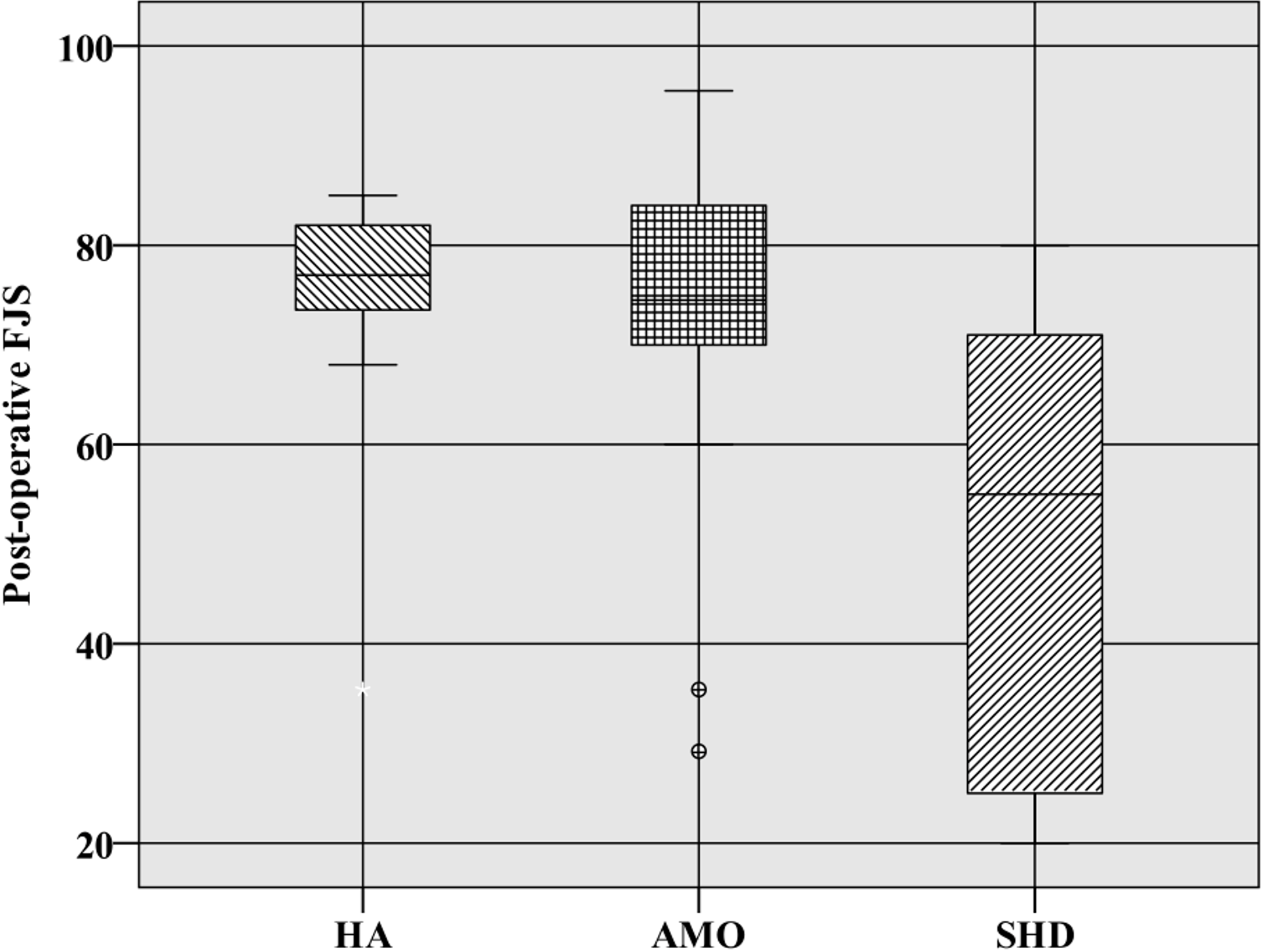
As the primary outcome measure, the mean post-operative FJS was 74.5 (±13.8) for the HA group, 72.6 (±17) for the AMO group and 52.7 (±24) for the SHD group (Figure 2). There was a significant difference between the groups (p=0.023) and when compared pairwise, SHD group was found to be significantly lower than both the HA group (p=0.012) and the AMO group (p=0.019).
When grouped according to treatment success based on the FJS, 28 patients (68.3%) resulted in a successful treatment meanwhile 13 patients (31.7%) were less successful. When success rates of the study groups are compared, a significant difference was found (p=0.039, Table 1). Table 2 summarizes the clinical and radiographic variables between the two groups. Two of the pre-operative features demonstrated significant difference between groups; the group regarded as unsuccessful had a higher percentage of patients with pre-operative Tönnis stage ≥2 (38.5% vs 7.2%, p=0.024), and also a higher pre-operative mean alpha angle (74.3 vs 66.6, p=0.042).
| Table 2. Clinical and radiographic variables of two groups according to treatment success based on FJS | |||
|
|
|
|
|
| Age (Mean±SD) |
|
|
|
| BMI (Mean±SD) |
|
|
|
| Labral tear | |||
| Not present |
|
|
|
| Present (Full thickness or degenerative) |
|
|
|
| Tönnis stage |
|
||
| <2 |
|
|
|
| ≥2 |
|
|
|
| Pre-operative alpha angle (Mean±SD) |
|
|
|
| Anterior offset (Mean±SD) |
|
|
|
| Lateral center edge angle (Mean±SD) |
|
|
|
| Acetabular angle (Mean±SD) |
|
|
|
| Tönnis angle (Mean±SD) |
|
|
|
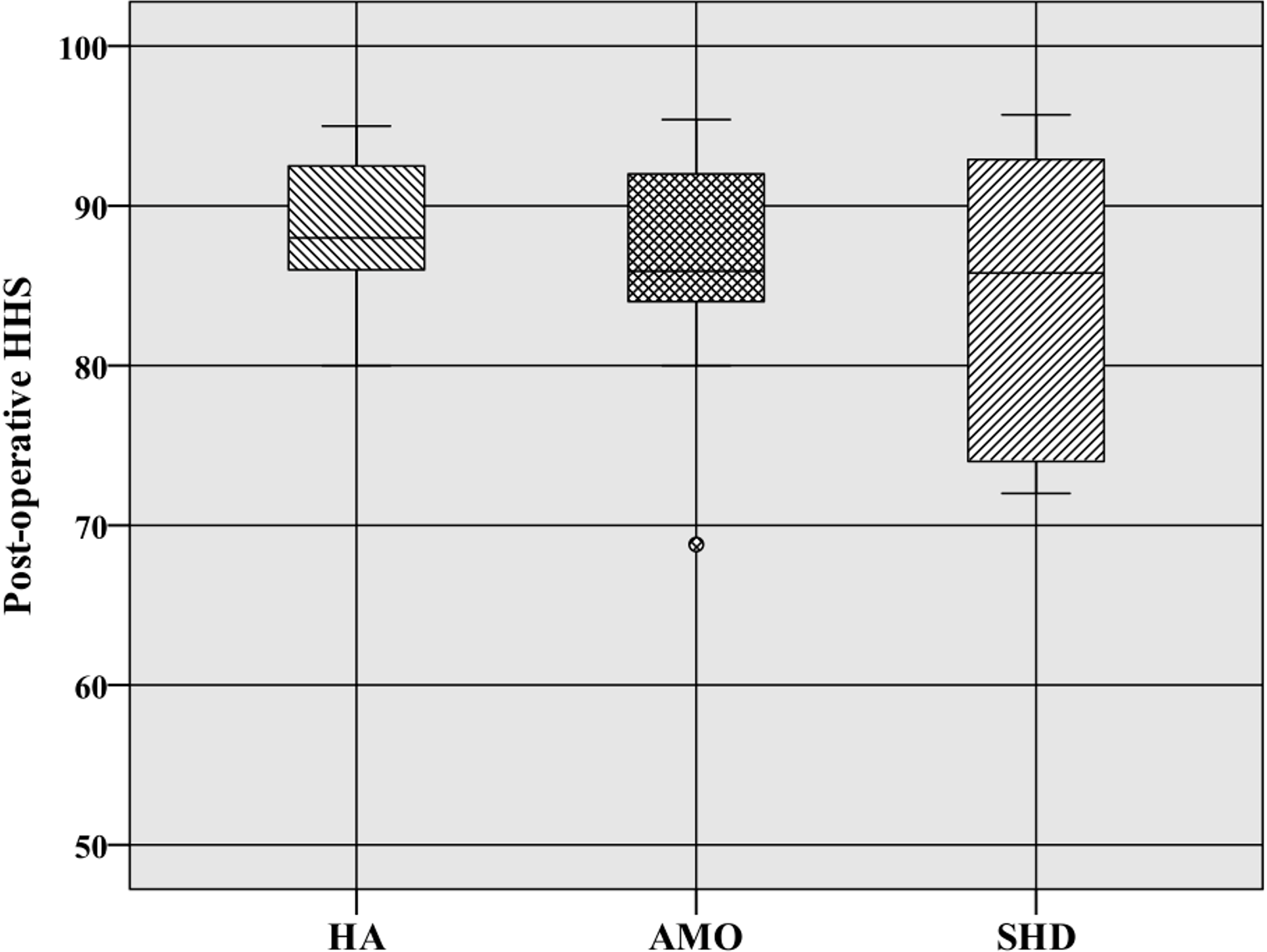
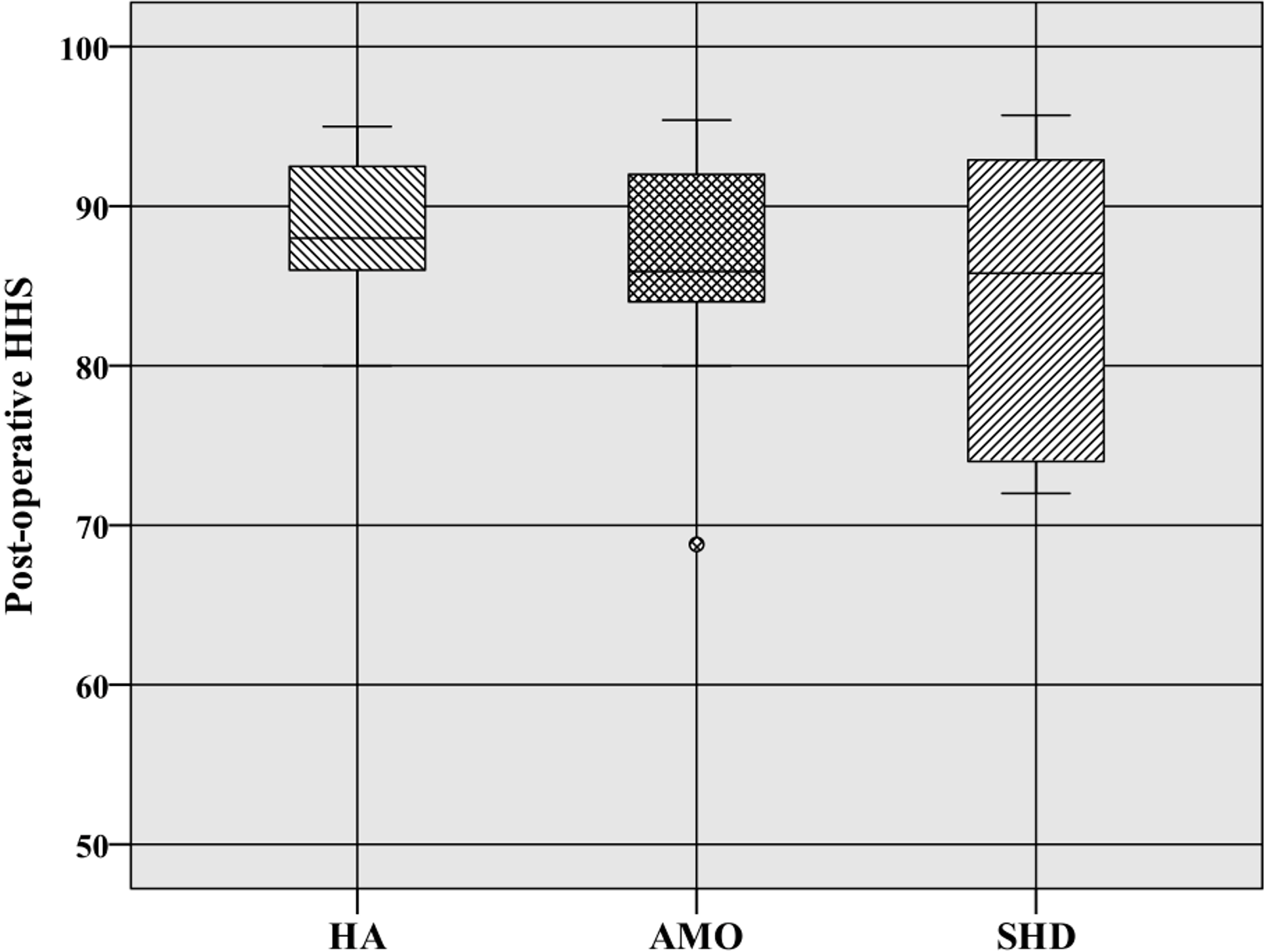
As the secondary outcome measures, post-operative HHS and UCLA activity indexes of the three surgery groups were compared (Table 1). The mean post-operative HHS (p=0.384) and UCLA activity indexes (p=0.848) were similar between the groups (Figure 3, Figure 4). HHS showed significant improvement after surgery, for each group, when compared to the pre-operative values: HA group increased from 68.8 (±6.9) to 88.0 (±4.9) (p<0.001), AMO group from 70.5 (±8) to 86.6 (±6.4) (p<0.001), and the SHD group from 72.4 (±8.6) to 84.3 (±9.5) (p=0.021). UCLA activity indexes also showed significant improvement for HA and AMO groups: HA group increased from 5.1 (±0.9) to 6.2 (±1.1) (p=0.003) and AMO group from 4.9 (±1.2) to 6.1 (±1.2) (p<0.001) post-operatively. The SHD group also showed a small improvement and increased from 5.4 (±1.8) to 5.9 (±1.1); but that did not reach significance statistically (p=0.225).
As another secondary outcome of our study, post-operative alpha angles were also measured (Table 1). The mean values were similar between the three study groups (p=0.597). All the groups showed significant reduction of the alpha angles when compared to the pre-operative mean values: HA group decreased from 64.1 (±12.7) to 41.9 (±11.7) (p<0.001), AMO group decreased from 67.5 (±6.6) to 39.1 (±6.5) (p<0.001) and the SHD group decreased from 79.7 (±15.1) to 37.7 (±11.9) (p<0.001).
A multivariate logistic regression analysis was performed with treatment success as the dependent variable, to analyse the effect of pre-operative factors on the possible outcome of the treatment. The pre-operative variables that are included in the analysis were; age, BMI, presence of a labral tear, Tönnis stage (dichotomized as ≥2 and <2), pre-operative alpha angle, femoral head-neck offset, lateral CEA, acetabular angle, Tönnis angle and the type of surgery performed (with SHD designated as the baseline). The results of the regression analysis are presented in Table 3. In the univariate analysis, three of the variables (Tönnis stage, pre-operative alpha angle, type of surgery performed) reached significance and entered the multivariate analysis. In the multivariate analysis, pre-operative alpha angle lost significance and two variables remained related with treatment success: Tönnis stage and type of surgery performed.
| Table 3. Results of the regression analysis | ||||
|
|
|
|||
|
|
|
|
|
|
| Tönnis stage |
|
|
|
|
| Type of surgery | ||||
| HA |
|
|
|
|
| AMO |
|
|
|
|
| Pre-operative alpha angle |
|
|
|
|
Discussion
Even though SHD allows more complete assessment of the hip joint, labral and acetabular pathologies, the trend in recent years is in favour of less invasive techniques. Today, SHD is preferred in selected cases with global pincer, where the posterior compartment of the hip joint should be seen, while HA and AMO are frequently preferred because of both decreased hospital stay and the shorter rehabilitation period [18].
In our study, demographic data in 3 different groups were similar. Only the alpha angle was higher in the SHD group pre-operatively. This difference in the pre-operative alpha angle was an indication to go for SHD in patients with severe deformity; but especially in the last few years, minimally invasive methods are more frequently utilized even for more severe deformities. Literature showed inferior results of hip arthroscopy in patients presenting with anterior acetabular insufficiency, acetabular dysplasia or aberrant femoral retroversion[19]. Although the pre-operative alpha score was higher in the SHD group, there was no statistically significant difference among the 3 groups in terms of post-operative alpha angles.
To the best of our knowledge, FJS-12 [20], which is a PROM with a lower ceiling effect, was applied in 3 different surgical method groups for the first time. Our results showed that; FJS-12 was found to be lower in the SHD group, which showed comparable functional results in terms of HHS and UCLA activity indexes. Capsulotomy, trochanteric osteotomy, existence of hardware, muscle damage and sacrificing the ligamentum teres all may contribute to a micro-instability and eventually increased joint awareness in the SHD group may be the cause of difference between groups. FJS-12, which has been used since 2012 to evaluate patient satisfaction especially after arthroplasty, is needed to be analysed on FAS patients with larger cohort series.
The number of studies comparing SHD, HA and AMO is limited in the literature and also outcome measurements differ considerably among studies. In the study of Beck et al., SHD was applied to 19 hips due to FAI, and 13 patients were classified as excellent-to-good based on Merle d’Aubigné-Postel score [21]. In the study by Domb. et al., which 10 SHD and 20 HA patients were evaluated, Non-Arthritic Hip Score (NASH) was significantly higher in the HA group (94.2 vs 85.7) [22]. Additionally, in the study by Byrd et al., it is stated that during the 10-year follow-up period of hip arthroscopy performed on 15 athletes, the median improvement in the modified Harris hip score was 45 points. Also, it was emphasized that HSS is not sufficiently sensitive and has a high ceiling effect [23].
There are some limitations to our study; the mean age was relatively young compared to the literature, and there was no THA conversion in any of the patients, since the follow-up period was midterm. For this reason, joint survival was not designated as an outcome as it is in many hip-preservation studies in the literature. In the multivariate analysis, a significant relationship was found between the Tönnis stage and surgical success. In previous studies, the relationship between the increase in the Tönnis stage and the failure of surgery and the return to THA have been shown[24,25]. Risk factors for treatment failure includes a longer mean symptomatic period before surgical procedure, older age, higher BMI, hip dysplasia, acetabular retroversion, higher pre-operative alpha angle, full thickness acetabular chondral lesion, higher Tönnis grade of osteoarthritis, labral hypertrophy and total labral resection. However, its relationship on joint awareness has not been documented in the literature. The follow-up period was found to be similar between the study groups, however, the wide range of follow-up for the whole study population (ranging between 16 to 256 months) is a significant source of heterogeneity. Finally, our study has a small sample size which may not be adequate to detect small differences in the outcomes. A significant difference has been found with regards to the primary outcome measure, postoperative FJS, therefore we elected not to run a post-hoc power analysis as part of the study. However, when an analysis is made with a small effect size (0.2), the post-hoc power is found to be less than 0.5, which shows that the study may be inadequately powered to show smaller differences in other variables.
In conclusion, all 3 surgical approaches provide similar radiological and functional results after midterm follow-up if evaluated with conventional outcome scores of HHS of UCLA. In that point, FJS appears to be a more sensitive outcome measure providing accuracy to demonstrate a functional difference. We believe that joint awareness is an important component of patient satisfaction, and it is closely related to the success of a surgical procedure. High joint awareness and low patient satisfaction are expected in patients with advanced arthritis (Tönnis stage≥2) or who were applied SHD regardless of the Tönnis stage, therefore early intervention before the development of advanced arthritis and less invasive techniques (HA and AMO) are preferable for FAI surgery.
Ethical approval
This study was approved by the Hacettepe Üniversitesi Klinik Araştırmalar Etik Kurulu (Date: January 15, 2019, Decision/Protocol No: GO209/01-15). Informed consent was obtained from all participants involved in this study.
Data availability statement
The data supporting the findings of this study are not publicly available due to containing information that could compromise the privacy of research participants.
Conflict of interest
The authors declare that this study was conducted in the absence of any commercial or financial relationships that could be construed as a potential conflict of interest.
Funding
The authors declare that this study received no funding.
Generative AI statement
The authors declare that no generative AI or AI-assisted technologies were used in the writing or preparation of this study.
References
- Ganz R, Leunig M, Leunig-Ganz K, Harris WH. The etiology of osteoarthritis of the hip: an integrated mechanical concept. Clin Orthop Relat Res 2008;466(2):264-72. https://doi.org/10.1007/s11999-007-0060-z
- Leunig M, Beaulé PE, Ganz R. The concept of femoroacetabular impingement: current status and future perspectives. Clin Orthop Relat Res 2009;467(3):616-22. https://doi.org/10.1007/s11999-008-0646-0
- Beck M, Kalhor M, Leunig M, Ganz R. Hip morphology influences the pattern of damage to the acetabular cartilage: femoroacetabular impingement as a cause of early osteoarthritis of the hip. J Bone Joint Surg Br 2005;87(7):1012-8. https://doi.org/10.1302/0301-620X.87B7.15203
- Ganz R, Gill TJ, Gautier E, Ganz K, Krügel N, Berlemann U. Surgical dislocation of the adult hip a technique with full access to the femoral head and acetabulum without the risk of avascular necrosis. J Bone Joint Surg Br 2001;83(8):1119-24. https://doi.org/10.1302/0301-620x.83b8.11964
- Bellotti V, Cardenas C, Astarita E, et al. Mini-open approach for femoroacetabular impingement: 10 years experience and evolved indications. Hip Int. 2016;26(Suppl 1):38-42. https://doi.org/10.5301/hipint.5000408
- Larson CM, Giveans MR. Arthroscopic management of femoroacetabular impingement: early outcomes measures. Arthroscopy 2008;24(5):540-6. https://doi.org/10.1016/j.arthro.2007.11.007
- Matsuda DK, Carlisle JC, Arthurs SC, Wierks CH, Philippon MJ. Comparative systematic review of the open dislocation, mini-open, and arthroscopic surgeries for femoroacetabular impingement. Arthroscopy 2011;27(2):252-69. https://doi.org/10.1016/j.arthro.2010.09.011
- Rego PA, Mascarenhas V, Oliveira FS, Pinto PC, Sampaio E, Monteiro J. Arthroscopic versus open treatment of cam-type femoro-acetabular impingement: retrospective cohort clinical study. Int Orthop 2018;42(4):791-7. https://doi.org/10.1007/s00264-017-3735-4
- Meyer DC, Beck M, Ellis T, Ganz R, Leunig M. Comparison of six radiographic projections to assess femoral head/neck asphericity. Clin Orthop Relat Res 2006;445:181-5. https://doi.org/10.1097/01.blo.0000201168.72388.24
- Sharp I. Acetabular dysplasia. The acetabular angle. J Bone Joint Surg. 1961;43(2):268-72. https://doi.org/10.1302/0301-620X.43B2.268
- Tönnis D, Heinecke A. Acetabular and femoral anteversion: relationship with osteoarthritis of the hip. J Bone Joint Surg Am 1999;81(12):1747-70. https://doi.org/10.2106/00004623-199912000-00014
- Harris WH. Traumatic arthritis of the hip after dislocation and acetabular fractures: treatment by mold arthroplasty. An end-result study using a new method of result evaluation. J Bone Joint Surg Am 1969;51(4):737-55. https://doi.org/10.2106/00004623-196951040-00012
- Zahiri CA, Schmalzried TP, Szuszczewicz ES, Amstutz HC. Assessing activity in joint replacement patients. J Arthroplasty 1998;13(8):890-5. https://doi.org/10.1016/s0883-5403(98)90195-4
- Hueter C. Grundriss der chirurgie. In: Fünfte abtheilung: die verletzung und krankheiten des hüftgelenkes, neunundzwanzigstes capitel. 2nd ed. Leipzig: FCW Vogel;1883:129-200.
- Behrend H, Giesinger K, Giesinger JM, Kuster MS. The “forgotten joint” as the ultimate goal in joint arthroplasty: validation of a new patient-reported outcome measure. J Arthroplasty 2012;27(3):430-436.e1. https://doi.org/10.1016/j.arth.2011.06.035
- Galea VP, Ingelsrud LH, Florissi I, et al. Patient-acceptable symptom state for the Oxford Hip Score and Forgotten Joint Score at 3 months, 1 year, and 2 years following total hip arthroplasty: a registry-based study of 597 cases. Acta Orthop 2020;91(4):372-7. https://doi.org/10.1080/17453674.2020.1750877
- Rosinsky PJ, Chen JW, Lall AC, Shapira J, Maldonado DR, Domb BG. Can we help patients forget their joint? Determining a threshold for successful outcome for the forgotten joint score. J Arthroplasty 2020;35(1):153-9. https://doi.org/10.1016/j.arth.2019.08.014
- Zingg PO, Ulbrich EJ, Buehler TC, Kalberer F, Poutawera VR, Dora C. Surgical hip dislocation versus hip arthroscopy for femoroacetabular impingement: clinical and morphological short-term results. Arch Orthop Trauma Surg 2013;133(1):69-79. https://doi.org/10.1007/s00402-012-1616-2
- Makhni EC, Ramkumar PN, Cvetanovich G, Nho SJ. Approach to the patient with failed hip arthroscopy for labral tears and femoroacetabular impingement. J Am Acad Orthop Surg 2020;28(13):538-45. https://doi.org/10.5435/JAAOS-D-16-00928
- Hamilton DF, Giesinger JM, MacDonald DJ, Simpson AHRW, Howie CR, Giesinger K. Responsiveness and ceiling effects of the Forgotten Joint Score-12 following total hip arthroplasty. Bone Joint Res 2016;5(3):87-91. https://doi.org/10.1302/2046-3758.53.2000480
- Beck M, Leunig M, Parvizi J, Boutier V, Wyss D, Ganz R. Anterior femoroacetabular impingement: part II. midterm results of surgical treatment. Clin Orthop Relat Res 2004;(418):67-73. https://doi.org/10.1097/00003086-200401000-00012
- Domb BG, Stake CE, Botser IB, Jackson TJ. Surgical dislocation of the hip versus arthroscopic treatment of femoroacetabular impingement: a prospective matched-pair study with average 2-year follow-up. Arthroscopy 2013;29(9):1506-13. https://doi.org/10.1016/j.arthro.2013.06.010
- Byrd JW, Jones KS. Hip arthroscopy in athletes: 10-year follow-up. Am J Sports Med 2009;37(11):2140-3. https://doi.org/10.1177/0363546509337705
- Botser IB, Smith TW, Jr., Nasser R, Domb BG. Open surgical dislocation versus arthroscopy for femoroacetabular impingement: a comparison of clinical outcomes. Arthroscopy 2011;27(2):270-8. https://doi.org/10.1016/j.arthro.2010.11.008
- Nwachukwu BU, Rebolledo BJ, McCormick F, Rosas S, Harris JD, Kelly BT. Arthroscopic versus open treatment of femoroacetabular impingement: a systematic review of medium- to long-term outcomes. Am J Sports Med 2016;44(4):1062-8. https://doi.org/10.1177/0363546515587719
Copyright and License
Copyright © 2026 The Author(s). This is an open access article distributed under the Creative Commons Attribution License (CC BY), which permits unrestricted use, distribution, and reproduction in any medium or format, provided the original work is properly cited.