


Abstract
Objective: This study aimed to evaluate the predictive value of the hemoglobin, albumin, lymphocyte, and platelet (HALP) score for lymph node metastasis (LNM) in patients with resectable gastric cancer and to investigate the relationship between hematological markers and LNM.
Materials and Methods: Patients who underwent surgery for gastric adenocarcinoma between 2020 and 2024 were retrospectively analyzed. Demographic data, comorbidities, and laboratory parameters were recorded, and the HALP score, neutrophil-to-lymphocyte ratio (NLR), platelet-to-lymphocyte ratio (PLR), and platelet-to-neutrophil ratio (PNR) were calculated. Tumor stage, nodal stage, and pathological features were reviewed. The optimal HALP cutoff value was determined by receiver operating characteristic (ROC) curve analysis. Variables significant in univariate analysis were included in multivariate logistic regression to identify independent risk factors for LNM.
Results: A total of 238 patients were included, with a mean age of 65.5 ± 11.4 years; 70.2% were male. The mean number of dissected lymph nodes was 26.0 ± 10.6, and the mean number of metastatic nodes was 6.2 ± 9.0. Perineural invasion (PNI) and lymphovascular invasion (LVI) were observed in 66.8% and 71.0% of patients, respectively. LNM was present in 159 patients (66.8%). In univariate analysis, a low HALP score, advanced invasion depth, and the presence of PNI and LVI were significantly associated with LNM (p < 0.005). ROC analysis identified an optimal HALP cutoff value of 17 (AUC = 0.581, p = 0.041). In multivariate analysis, invasion depth (p = 0.001), PNI (p = 0.008), and LVI (p < 0.001) were independent predictors of LNM, whereas the HALP score was not (p = 0.221).
Conclusion: In resectable gastric cancer, a low HALP score was associated with lymph node metastasis but was not confirmed as an independent predictive factor. As a composite parameter reflecting systemic inflammation and immune–nutritional status, the HALP score may indicate tumor aggressiveness and poor prognosis. Preoperative recognition of low HALP(<17) scores may help identify patients requiring closer monitoring for LNM risk.
Keywords: gastric cancer, lymphatic metastasis, prognostic factors, HALP score
Introduction
Gastric cancer is the fifth most common malignancy worldwide and remains one of the leading causes of cancer-related mortality [1]. Adenocarcinoma is the predominant histopathological type, accounting for approximately 95% of all cases [2]. Owing to the fact that gastric cancer is frequently diagnosed at advanced stages, the overall prognosis is generally poor. The TNM staging system, which incorporates tumor depth, lymph node involvement, and distant metastasis, is the most widely accepted and clinically relevant determinant of prognosis [3].
In recent years, several hematological and biochemical parameters—including the neutrophil-to-lymphocyte ratio (NLR), platelet-to-lymphocyte ratio (PLR), C-reactive protein (CRP), and albumin-to-alkaline phosphatase ratio (AAPR)—have been investigated for their potential role in predicting lymph node metastasis. Findings suggest that these markers may provide additional prognostic information in gastric cancer [4,5]. Moreover, the hemoglobin, albumin, lymphocyte, and platelet (HALP) score, which reflects both nutritional and immunological status, has emerged as a novel biomarker with reported predictive value for lymph node metastasis [6,7]. For example, Çağlıyan et al. demonstrated that a lower HALP score was associated with lymph node metastasis and poorer prognosis in patients with colorectal cancer [8]. Other studies similarly suggest that a low HALP score correlates with advanced tumor stage, increased lymph node involvement, and decreased survival rates [9]. Nevertheless, evidence regarding the clinical utility of the HALP score in gastric cancer remains limited. Although previous studies examined HALP in predicting survival, its role in predicting LNM in the Turkish population remains unclear.
The primary aim of this study was to evaluate the predictive value of the HALP score for lymph node metastasis in patients with gastric cancer. A secondary objective was to explore the association between other hematological markers and lymph node metastasis.
Materials and methods
This study was approved by the Ethics Committee of Bilkent City Hospital (Decision No: TABED 1-25-1790) and conducted in accordance with the principles of the Declaration of Helsinki (revised in 2013). A retrospective cohort design was employed. Patients aged 18 years or older who underwent surgery for gastric adenocarcinoma at our clinic between 2020 and 2024 were included. Exclusion criteria were as follows: gastrectomy performed for indications other than adenocarcinoma (e.g., neuroendocrine tumors, lymphoma), concomitant malignancies, chronic inflammatory, hematological, or autoimmune diseases that could influence hematological parameters, history of corticosteroid use, presence of acute infection, receipt of neoadjuvant therapy (to avoid confounding of hematologic parameters), availability of fewer than 15 lymph nodes in the pathology specimen, and incomplete clinical data.
Data were retrieved from patient medical records and the hospital database. Demographic variables (age, sex), comorbidities (diabetes mellitus, hypertension, coronary artery disease, chronic obstructive pulmonary disease), and laboratory parameters [hemoglobin (g/dL), albumin (g/L), neutrophils (×10⁹/L), lymphocytes (×10⁹/L), platelets (×10⁹/L)] were recorded. Derived indices were calculated as follows: platelet-to-lymphocyte ratio (PLR = platelets/lymphocytes), platelet-to-neutrophil ratio (PNR = platelets/neutrophils), and HALP score [hemoglobin (g/dL) × albumin (g/L) × lymphocytes (×10⁹/L) / platelets (×10⁹/L)]. Laboratory values were obtained from blood samples collected within one week prior to surgery.
Clinicopathological features, including tumor stage (T), nodal status (N), overall stage, perineural invasion (PNI), lymphovascular invasion (LVI), total number of lymph nodes, and number of positive lymph nodes, were extracted from postoperative pathology reports. Tumor, nodal, and stage classifications were based on the 8th edition of the American Joint Committee on Cancer (AJCC) staging system [3]. For additional analysis, tumor invasion depth was categorized into two groups according to T stage: T1–2 and T3–4.
Statistical analysis
Categorical variables were presented as frequency and percentage and continuous variables as means and standard deviation. Mann-Whitney U test was used to compare continuous variables. Fisher’s Exact Chi-square test was used to compare categorical variables. The ROC curve was used to determine the optimum cut-off values for HALP score which is associated with lymph node metastasis (based on Youden’s J index from the ROC curve). Variables that showed significant correlation in the univariate analysis were evaluated by multivariate binary logistic regression analysis to determine the risk factors associated with lymph node metastasis and to calculate the odds ratio with 95% CI. All analyses were performed using the Statistical Package for the Social Sciences for Windows version 22.0 (SPSS Inc., Chicago, Illinois, USA). The level of statistical significance was set at p<0.05.
Results
A total of 238 patients were included in the study. The mean age was 65.5 ± 11.4 years, and the cohort consisted of 71 females (29.8%) and 167 males (70.2%). The mean follow-up duration was 27.4 ± 17.2 months. Total gastrectomy was performed in 136 patients (57.1%), while 102 patients (42.9%) underwent subtotal gastrectomy. The demographic characteristics of the study population are summarized in Table 1.
| SD: standart deviation | |
| Table 1. Demographic data | |
| Variable |
|
| Age (years) (mean±SD) |
|
| Gender (n/%) | |
| Female |
|
| Male |
|
| Smoking Status (n/%) | |
| Non-smoker |
|
| Smoker |
|
| DM (n/%) | |
| Non-present |
|
| Present |
|
| HT (n/%) | |
| Non-present |
|
| Present |
|
| CAD (n/%) | |
| Non-present |
|
| Present |
|
| COPD (n/%) | |
| Non-present |
|
| Present |
|
| HALP score (mean±SD) |
|
| NLR (mean±SD) |
|
| PLR (mean±SD) |
|
| PNR (mean±SD) |
|
When clinicopathological data were evaluated, the mean number of dissected lymph nodes was 26.0 ± 10.6, while the mean number of metastatic lymph nodes was 6.2 ± 9.0. Perineural invasion (PNI) was identified in 159 patients (66.8%), and lymphovascular invasion (LVI) was present in 169 patients (71.0%). The clinicopathological characteristics of the patients are summarized in Table 2.
| Table 2. Clinicopathological data | |
|---|---|
| SD: standart deviation | |
| Variable |
|
| T (n/%) | |
| 1A |
|
| 1B |
|
| 2 |
|
| 3 |
|
| 4A |
|
| N (n/%) | |
| 0 |
|
| 1 |
|
| 2 |
|
| 3A |
|
| 3B |
|
| Stage (n/%) | |
| 1A |
|
| 1B |
|
| 2A |
|
| 2B |
|
| 3A |
|
| 3B |
|
| 3C |
|
| Perineural invasion | |
| None |
|
| Yes |
|
| Lymphovascular invasion | |
| None |
|
| Yes |
|
| Total lymph node number (mean±SD) |
|
| Positive lymph node number (mean±SD) |
|
| Depth of invasion(n/%) | |
| T1/2 |
|
| T3/4 |
|
Patients were classified into two groups: those without lymph node metastasis (N0) (79 patients, 33.2%) and those with lymph node metastasis (N1–3) (159 patients, 66.8%). In univariate analysis, the HALP score, tumor invasion depth, perineural invasion, and lymphovascular invasion were significantly associated with lymph node metastasis (p < 0.005) (Table 3).
| SD: standart deviation, a Mann-Whitney U Test, b Fisher’s Exact Test | |||
| Table 3. Univariate analysis of factors associated with lymph node metastasis | |||
|
|
|
|
|
| Age (years) (mean±SD) |
|
|
|
| Gender (n/%) |
|
||
| Female |
|
|
|
| Male |
|
|
|
| DM (n/%) |
|
||
| Non-present |
|
|
|
| Present |
|
|
|
| HT (n/%) |
|
||
| Non-present |
|
|
|
| Present |
|
|
|
| CAD (n/%) |
|
||
| Non-present |
|
|
|
| Present |
|
|
|
| COPD (n/%) |
|
||
| Non-present |
|
|
|
| Present |
|
|
|
| HALP score (mean±SD) |
|
|
|
| NLR (mean±SD) |
|
|
|
| PLR (mean±SD) |
|
|
|
| PNR (mean±SD) |
|
|
|
| Depth of invasion(n/%) |
|
||
| T1/2 |
|
|
|
| T3/4 |
|
|
|
| Perineural invasion |
|
||
| None |
|
|
|
| Yes |
|
|
|
| Lymphovascular invasion |
|
||
| None |
|
|
|
| Yes |
|
|
|
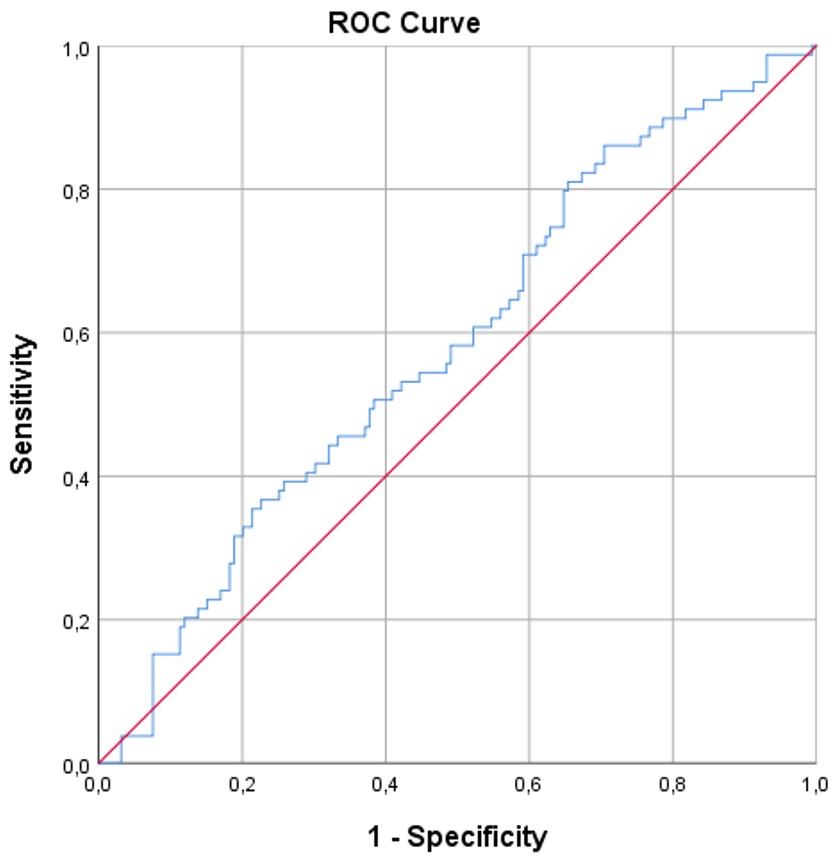
The optimal cutoff value for the HALP score was determined to be 17, based on receiver operating characteristic (ROC) curve analysis using Youden’s J index. This threshold yielded a sensitivity of 86.1% and a specificity of 29.6% (AUC: 0.581, 95% CI: 0.505–0.657, p = 0.041) (Figure 1).
Variables that were significant in univariate analysis were subsequently included in the multivariate logistic regression model. Tumor invasion depth (OR: 0.127, 95% CI: 0.039–0.413, p = 0.001), perineural invasion (OR: 0.276, 95% CI: 0.107–0.716, p = 0.008), and lymphovascular invasion (OR: 0.055, 95% CI: 0.021–0.140, p < 0.001) were identified as independent risk factors for lymph node metastasis (Table 4).
| OR: Odds ratio, CI: Confidence interval | |||
| Table 4. Multivariate analysis of factors associated with lymph node metastasis | |||
|
|
|
|
|
| HALP score |
|
|
|
| Depth of invasion(n/%) |
|
|
|
| Perineural invasion |
|
|
|
| Lymphovascular invasion |
|
|
|
Discussion
In the present study, univariate analyses demonstrated a significant association between the HALP score, tumor invasion depth, perineural invasion (PNI), lymphovascular invasion (LVI), and the presence of lymph node metastasis (LNM) in patients with resectable gastric adenocarcinoma. However, in multivariate logistic regression analysis, only invasion depth, PNI, and LVI were identified as independent predictive factors for LNM, whereas the HALP score did not retain statistical significance. Receiver operating characteristic (ROC) analysis indicated a HALP cutoff value of 17, which yielded high sensitivity (86.1%) but low specificity (29.1%) (AUC: 0.581, 95% CI: 0.505–0.657, p = 0.041). PNI and LVI were observed in 66.8% and 71.0% of patients, respectively, indicating a high prevalence of aggressive pathology included in the model. This suggests that the effect of hematological parameters may be overshadowed. Also the low specificity of HALP cut-off value can be explained by this way. While this limits the utility of the HALP score as a standalone predictor of LNM, it still holds value as a complementary marker in the broader prognostic assessment of gastric cancer.
Wang et al. reported that the HALP score was an independent risk factor for LNM in patients with gastric cancer, with an odds ratio of 2.276 (p = 0.032) [10]. In that study, the HALP score, when combined with tumor invasion depth and tumor markers (CEA, CA19-9), demonstrated strong predictive performance for LNM. In our study HALP score was significantly higher in the lymph node–positive group (p = 0.041). Differences in study populations, sample sizes, and the range of variables incorporated into statistical models may partly explain these discrepancies.
Chen et al. analyzed a large cohort of 1,332 patients and demonstrated that the HALP score was closely associated with clinicopathological characteristics, as well as survival outcomes [11]. Patients with a HALP score <56.8 were more likely to present with advanced T and N stages, whereas those with a HALP score ≥56.8 exhibited significantly longer median survival and improved 1-, 2-, and 3-year survival rates. These results indicate that worsening prognosis parallels the increased frequency of lymph node metastasis, and that lymph node involvement adversely impacts overall survival.
In a more recent study, Aoyama et al. (2024) reported 5-year overall survival rates of 57.2% in patients with HALP ≤40 and 85.8% in those with HALP >40 who underwent curative gastrectomy. Furthermore, multivariate analysis identified a low HALP score as an independent risk factor for survival (HR = 2.679, p = 0.002). Similarly, Sargın et al. demonstrated that patients with higher HALP scores had significantly longer overall survival in gastric carcinoma [12].
Taken together, these findings suggest that a low HALP score reflects impaired nutritional and immune status, which may contribute to more aggressive tumor biology, progression, and worse survival outcomes. HALP score is statistical significance in univariate analysis—combined with robust evidence from prior studies—supports its potential role as a clinically valuable prognostic marker in gastric cancer.
Köşeci et al. evaluated the role of the HALP score in predicting perioperative treatment response in early-stage gastric cancer and reported a significantly higher pathological response rate among patients with a HALP score ≥28.9 [13]. In our study, treatment response parameters were not analyzed because neoadjuvant therapy was not administered, as such treatment could potentially influence hematological parameters. Nevertheless, the findings of Köşeci et al. support the notion that the HALP score may reflect tumor biology and sensitivity to therapy.
In our series, other hematological inflammatory indices such as the neutrophil-to-lymphocyte ratio (NLR), platelet-to-lymphocyte ratio (PLR), and platelet-to-neutrophil ratio (PNR) were not significantly associated with lymph node metastasis. However, numerous studies in the literature have demonstrated the prognostic relevance of NLR and PLR in gastric cancer. For example, Gunaldi et al. analyzed 245 patients in Turkey and showed that patients with elevated NLR were more frequently diagnosed at advanced stages (55.9% with high NLR) and were more likely to present with lymph node metastases. Elevated PLR was correlated with deeper tumor invasion (T3/4) and higher stage. Furthermore, this study reported that baseline NLR at the time of diagnosis was a significant prognostic factor for survival and could even aid in guiding surgical and treatment strategies. Interestingly, PLR did not show a significant association with survival in the same cohort [4].
Consistent with these findings, Zhang et al. conducted a large meta-analysis and demonstrated that elevated preoperative PLR was associated with poorer prognosis in gastric cancer patients (HR = 1.37, 95% CI: 1.26–1.49) and significantly increased the risk of lymph node metastasis (OR = 1.17, 95% CI: 1.02–1.33) [6]. Although no statistical association was identified for PLR or PNR in our cohort, the cumulative evidence suggests that systemic inflammatory markers may provide insight into tumor biology and metastatic potential. Variations in cutoff values, sample sizes, and heterogeneity among study populations likely contribute to the discrepancies observed across studies. Among these indices, the prognostic significance of NLR appears more consistent, whereas the role of PLR remains less definitive.
The findings of our study indicate that a low HALP score may be associated with more aggressive pathological features and the presence of lymph node metastasis in gastric cancer. As a composite parameter reflecting both systemic inflammation and immune–nutritional status, the HALP score provides a broader prognostic perspective than individual hematological indices. Although its specificity is limited, the HALP score should not be overlooked in clinical practice. In the preoperative setting, a low HALP score—easily obtained without additional investigations—may serve as a practical marker to identify patients who require closer monitoring and heightened vigilance regarding the risk of lymph node metastasis. Although HALP was not an independent predictor, its easy preoperative calculation may complement existing risk models. Prospective multicenter validation is warranted.
Taken together with evidence from the current literature, our results suggest that integrated indices such as the HALP score may hold potential value not only for prognostic assessment but also for guiding treatment planning in patients with gastric cancer.
Ethical approval
This study was approved by the Ethics Committee of Bilkent City Hospital (Date: October 22, 2025, Decision/Protocol No: TABED 1-25-1790). Informed consent was obtained from all participants involved in this study.
Data availability statement
The data that support the findings of this study are available from the corresponding author upon reasonable request.
Conflict of interest
The authors declare that this study was conducted in the absence of any commercial or financial relationships that could be construed as a potential conflict of interest.
Funding
The authors declare that this study received no funding.
Generative AI statement
The authors declare that no generative AI or AI-assisted technologies were used in the writing or preparation of this study.
References
- Sung H, Ferlay J, Siegel RL, et al. Global cancer statistics 2020: GLOBOCAN estimates of incidence and mortality worldwide for 36 cancers in 185 countries. CA Cancer J Clin 2021;71(3):209-49. https://doi.org/10.3322/caac.21660
- Ma J, Shen H, Kapesa L, Zeng S. Lauren classification and individualized chemotherapy in gastric cancer. Oncol Lett 2016;11(5):2959-64. https://doi.org/10.3892/ol.2016.4337
- Amin MB, Greene FL, Edge SB, et al. The Eighth Edition AJCC Cancer Staging Manual: Continuing to build a bridge from a population-based to a more “personalized” approach to cancer staging. CA Cancer J Clin 2017;67(2):93-9. https://doi.org/10.3322/caac.21388
- Gunaldi M, Goksu S, Erdem D, et al. Prognostic impact of platelet/lymphocyte and neutrophil/lymphocyte ratios in patients with gastric cancer: a multicenter study. Int J Clin Exp Med 2015;8(4):5937-42.
- Yamanaka T, Matsumoto S, Teramukai S, Ishiwata R, Nagai Y, Fukushima M. The baseline ratio of neutrophils to lymphocytes is associated with patient prognosis in advanced gastric cancer. Oncology 2007;73(3-4):215-20. https://doi.org/10.1159/000127412
- Zhang T, Liu W, Xu C. Correlation analysis of hemoglobin, albumin, lymphocyte, platelet score and platelet to albumin ratio and prognosis in patients with lung adenosquamous carcinoma. Front Oncol 2023;13:1166802. https://doi.org/10.3389/fonc.2023.1166802
- Yalav O, Topal U, Unal AG, Eray IC. Prognostic significance of preoperative hemoglobin and albumin levels and lymphocyte and platelet counts (HALP) in patients undergoing curative resection for colorectal cancer. Ann Ital Chir 2021;92:283-92.
- Çağlıyan Ö, Yazıcı H, Yaşar AC, et al. Could the HALP score indicate poor prognosis in colorectal cancer patients? Turk J Surg 2025;41(2):154-9. https://doi.org/10.47717/turkjsurg.2025.6760
- Xu SS, Li S, Xu HX, et al. Haemoglobin, albumin, lymphocyte and platelet predicts postoperative survival in pancreatic cancer. World J Gastroenterol 2020;26(8):828-38. https://doi.org/10.3748/wjg.v26.i8.828
- Wang X, He Q, Liang H, et al. A novel robust nomogram based on preoperative hemoglobin and albumin levels and lymphocyte and platelet counts (HALP) for predicting lymph node metastasis of gastric cancer. J Gastrointest Oncol 2021;12(6):2706-18. https://doi.org/10.21037/jgo-21-507
- Chen XL, Xue L, Wang W, et al. Prognostic significance of the combination of preoperative hemoglobin, albumin, lymphocyte and platelet in patients with gastric carcinoma: a retrospective cohort study. Oncotarget 2015;6(38):41370-82. https://doi.org/10.18632/oncotarget.5629
- Aoyama T, Maezawa Y, Hashimoto I, et al. The clinical impact of Hemoglobin, Albumin, Lymphocyte, Platelet (HALP) in gastric cancer patients who receive curative treatment. In Vivo 2024;38(5):2494-500. https://doi.org/10.21873/invivo.13720
- Köşeci T, Seyyar M, Aydınalp Camadan Y, et al. HALP score in predicting response to treatment in patients with early-stage gastric cancer: a multi-centred retrospective cohort study. Medicina (Kaunas) 2024;60(12):2087. https://doi.org/10.3390/medicina60122087
Copyright and License
Copyright © 2026 The Author(s). This is an open access article distributed under the Creative Commons Attribution License (CC BY), which permits unrestricted use, distribution, and reproduction in any medium or format, provided the original work is properly cited.