

Abstract
Objective: The European LeukemiaNet (ELN) 2022 risk classification for acute myeloid leukemia (AML) was primarily developed in cohorts treated with intensive chemotherapy and has demonstrated limited prognostic discrimination in AML patients receiving less-intensive regimens. The recently proposed ELN 2024 classification aims to refine risk stratification in patients treated with less-intensive regimens. We compared the prognostic performance of ELN 2022 and ELN 2024 in a real-world cohort of unfit AML patients treated with azacitidine plus venetoclax.
Materials and Methods: In this retrospective single-center study, 39 newly diagnosed AML patients treated with first-line azacitidine and venetoclax between January 2023 and September 2025 were included. Patients were stratified according to ELN 2022 and ELN 2024 criteria. Overall survival (OS) was analyzed using Kaplan–Meier estimates, log-rank tests, Cox regression, and Harrell’s concordance index (C-index).
Results: Median age was 70 years (range, 60–84). Secondary AML was present in 33.3%, and 30.8% harbored TP53 mutations. Under ELN 2022, 64.1% of patients were classified as adverse risk compared with 30.8% under ELN 2024. ELN 2022 did not significantly stratify OS in either three-group or dichotomized analyses (p=0.265 and p=0.199, respectively). In contrast, dichotomized ELN 2024 demonstrated significant survival separation (p=0.041). Adverse risk according to ELN 2024 was associated with inferior OS (HR 2.41, 95% CI 0.98–5.94; p=0.057). The highest discriminatory capacity was observed with the dichotomized ELN 2024 model (C-index 0.697; p=0.021).
Conclusion: In AML patients treated with hypomethylating agents plus venetoclax, ELN 2024 provides improved prognostic discrimination compared with ELN 2022. These findings support the clinical relevance of treatment-context–specific risk stratification in the venetoclax era.
Keywords: acute myeloid leukemia, ELN 2024, genetic risk stratification, venetoclax, hypomethylating agents
Introduction
Acute myeloid leukemia (AML) is a biologically heterogeneous malignancy with historically poor outcomes in older or medically unfit patients who are ineligible for intensive induction chemotherapy. Prior to 2018, treatment options for this population were largely limited to hypomethylating agents (HMAs) or low-dose cytarabine, with median overall survival (OS) rarely exceeding one year [1]. The U.S. Food and Drug Administration’s approval of the BCL-2 inhibitor venetoclax in combination with azacitidine or decitabine in 2018 marked a pivotal turning point in AML therapy, leading to substantially higher response rates and improved survival in patients previously considered to have a dismal prognosis [2].
In parallel with therapeutic advances, rapid progress in genomic profiling has fundamentally reshaped risk assessment in AML. Molecular and cytogenetic abnormalities are currently recognized as key determinants of treatment response and survival, forming the backbone of European LeukemiaNet (ELN) risk classifications [3,4]. However, the ELN 2017 and subsequently ELN 2022 recommendations were derived predominantly from cohorts treated with intensive chemotherapy and were not designed to stratify outcomes in patients receiving less-intensive, HMA-based regimens [4,5]. As a result, validation studies in venetoclax-treated or HMA-treated older patients demonstrated suboptimal prognostic discrimination, with a disproportionate number of patients being assigned to the adverse-risk category [6].
These limitations prompted the development of the ELN 2024 genetic risk classification for patients receiving less-intensive therapies, which represents a conceptual shift from therapy-agnostic to treatment-context–specific prognostication. The ELN 2024 framework integrates emerging real-world and clinical trial data from patients treated with HMA monotherapy, HMA plus venetoclax, or azacitidine plus targeted agents such as ivosidenib. Importantly, it emphasizes the dominant adverse prognostic impact of TP53 mutations, while identifying favorable-risk subgroups such as DDX41-mutated or selected NPM1- and IDH-mutated AML, particularly in the absence of activating signaling mutations [6].
Given the widespread adoption of venetoclax-based regimens in real-world clinical practice, there remains a critical unmet need to determine whether the ELN 2024 classification provides superior prognostic stratification compared with ELN 2022 in this specific therapeutic setting. Accordingly, in our study, we aimed to compare the prognostic performance of the ELN 2022 and ELN 2024 risk classifications in patients with AML treated with a combination of HMAs and BCL-2 inhibitors, and to evaluate their ability to discriminate survival outcomes within a real-world cohort.
Materias and Methods
Study design and patient population
This retrospective, single-center observational cohort study included consecutive adult patients (≥18 years) with newly diagnosed AML according to the 2022 World Health Organization (WHO) and International Consensus Classification (ICC) criteria between January 2023 and September 2025 [7,8].
All patients received first-line therapy with azacitidine in combination with venetoclax at the Department of Hematology, Ankara Etlik City Hospital, and those who received at least one dose of both agents were included in the analysis.
The study was approved by the Ankara Etlik City Hospital Ethics Committee (Date: 28-05-2025; Approval No: AEŞH-BADEK1-2025-086) and conducted in accordance with the Declaration of Helsinki.
Data collection and molecular analyses
Demographic, clinical, and laboratory data were retrieved from electronic and paper-based medical records. Collected variables included age at diagnosis, sex, comorbidities, prior azacitidine exposure, cytogenetic findings, and molecular abnormalities at diagnosis.
Conventional cytogenetic analysis was performed using G-banding. Fluorescence in situ hybridization (FISH) was conducted to detect recurrent chromosomal abnormalities, including del(5q), del(7q), +8, del(20q), t(8;21), t(15;17), inv(16), t(9;22), KMT2A rearrangements, DEK/NUP214, and inv(3).
Molecular Profiling and Next-Generation Sequencing (NGS)
Comprehensive somatic genomic profiling was performed using a high-throughput targeted NGS approach designed to evaluate 74 genes frequently mutated in myeloid malignancies and bone marrow failure syndromes. The panel targeted the complete coding regions and essential splice sites of a broad gene set, including NPM1, FLT3 (ITD and TKD), DNMT3A, TET2, TP53, ASXL1, RUNX1, IDH1/2, as well as markers for telomere maintenance (TERC, TERT) and ribosome biogenesis (SBDS, RPL23).
Genomic DNA was isolated from bone marrow aspirates or peripheral blood samples obtained at diagnosis. Library preparation was performed using the SOPHiA™ Myeloid Custom Solution (SOPHiA GENETICS, Saint-Sulpice, Switzerland), employing a hybrid-capture-based target-enrichment methodology. This approach was selected for its superior capacity to provide uniform coverage and detection internal tandem duplications. Sequencing was performed on the Illumina NextSeq 2000 (Illumina, San Diego, CA, USA) platform.
Somatic variants were interpreted and categorized according to the Joint Consensus Recommendations of the Association for Molecular Pathology (AMP), American Society of Clinical Oncology (ASCO), and College of American Pathologists (CAP). A variant allele frequency (VAF) threshold of ≥5% was utilized for clinical risk stratification. However, variants with lower VAFs were meticulously evaluated for key driver genes, such as TP53, where subclonal mutations may carry independent prognostic weight. Based on cytogenetic and molecular findings at diagnosis, patients were stratified according to both the ELN 2022 and ELN 2024 risk classifications.
Endpoints
The primary endpoint of the study was OS, defined as the time from AML diagnosis to death from any cause. Patients who were alive at the time of last follow-up were censored accordingly.
Statistical analysis
All statistical analyses were performed using IBM SPSS Statistics version 25.0 (IBM Corp., Armonk, NY, USA). Categorical variables were expressed as frequencies and percentages. Continuous variables were reported as median and range.
Survival probabilities were estimated using the Kaplan–Meier method and compared between groups using the log-rank test. Cox proportional hazards regression analysis was performed to estimate hazard ratios (HRs) and 95% confidence intervals (CIs). Prognostic discrimination was evaluated using Harrell’s concordance index (C-index). To enhance statistical robustness given the small sample size, additional dichotomized analyses (favorable/intermediate vs adverse risk) were performed for both ELN 2022 and ELN 2024. A two-sided p-value <0.05 was considered statistically significant.
Results
A total of 39 patients were included in the study. The median age at diagnosis was 70 years (range, 60–84), and 56.4% of the cohort were male. Baseline demographic, clinical, and molecular characteristics were summarized in Table 1. The most frequently mutated genes identified by NGS were NPM1 (32.4%), DNMT3A (23.5%), TET2 (23.5%), SRSF2 (23.5%), FLT3 (20.6%), ASXL1 (20.6%), and TP53 (20.6%). When patients harboring TP53 mutations detected by Sanger sequencing were additionally included, the overall prevalence of TP53 mutations in the entire cohort increased to 30.8%. Secondary AML accounted for 33.3% of cases, and 20.5% of patients had a documented history of prior azacitidine exposure.
| (ELN, European LeukemiaNet; HSCT, hematopoietic stem cell transplantation; NGS, next-generation sequencing) *Secondary AML included patients with therapy-related AML and those with a documented history of myelodysplastic syndrome or chronic myelomonocytic leukemia prior to AML diagnosis. **NGS-based molecular profiling was performed in 34 patients. Mutation frequencies were calculated exclusively among patients who underwent NGS testing. The TP53 mutation rate presented in the table includes only mutations identified by NGS. | |
| Table 1. Baseline demographic, clinical, and molecular characteristics of the study cohort | |
| Characteristics |
|
| Age at diagnosis, years | |
| Median (Range) |
|
| Age categories, n (%) | |
| 60-69 years |
|
| 70-79 years |
|
| 80-85 years |
|
| Sex, n (%) | |
| Female |
|
| Male |
|
| ELN 2022 risk classification, n (%) | |
| Favorable |
|
| Intermediate |
|
| Adverse |
|
| ELN 2024 risk classification, n (%) | |
| Favorable |
|
| Intermediate |
|
| Adverse |
|
| Prior exposure to azacitidine, n (%) |
|
| Secondary AML*, n (%) |
|
| Recurrent gene mutations detected by NGS**, n (%) (N: 34) | |
| NPM1 |
|
| FLT3 |
|
| DNMT3A |
|
| TP53 |
|
| IDH 1 – IDH 2 |
|
| KRAS – NRAS |
|
| RUNX1 |
|
| TET2 |
|
| CEBPA |
|
| ASXL1 |
|
| PTPN11 |
|
| SRSF2 |
|
| BCOR |
|
| Others (ATM, DDX41, JAK2, RAD21, SETBP1, SF3B1, STAG2, U2AF1) |
|
| Allogeneic HSCT performed, n (%) |
|
| Median follow-up, months (IQR) |
|
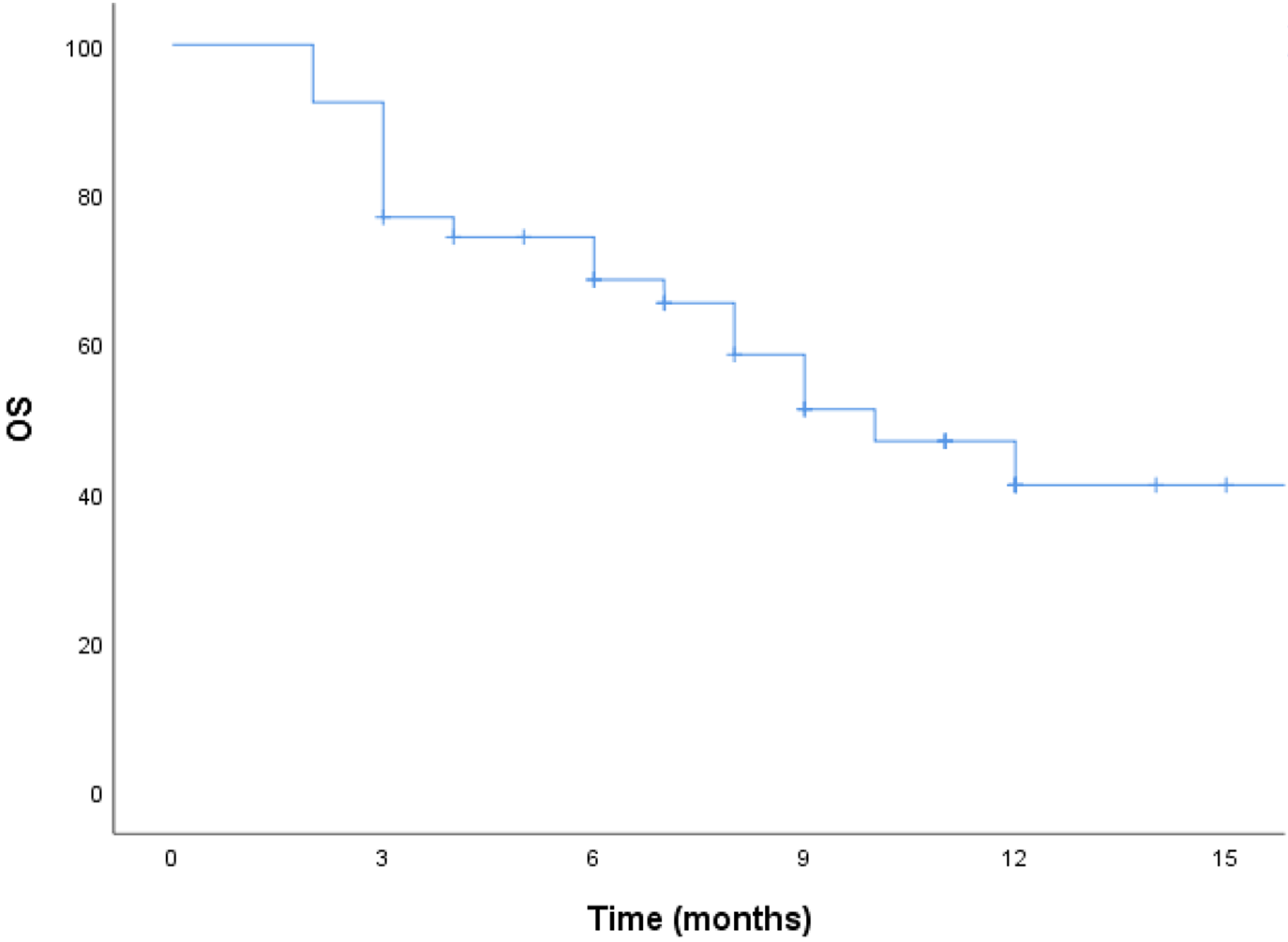
The median follow-up was 7 months (IQR, 3–11). During follow-up, 20 deaths were observed, providing the basis for the OS analyses. Kaplan–Meier analysis of OS for the entire cohort is shown in Figure 1, yielding an estimated 12-month OS rate of 41.1%.
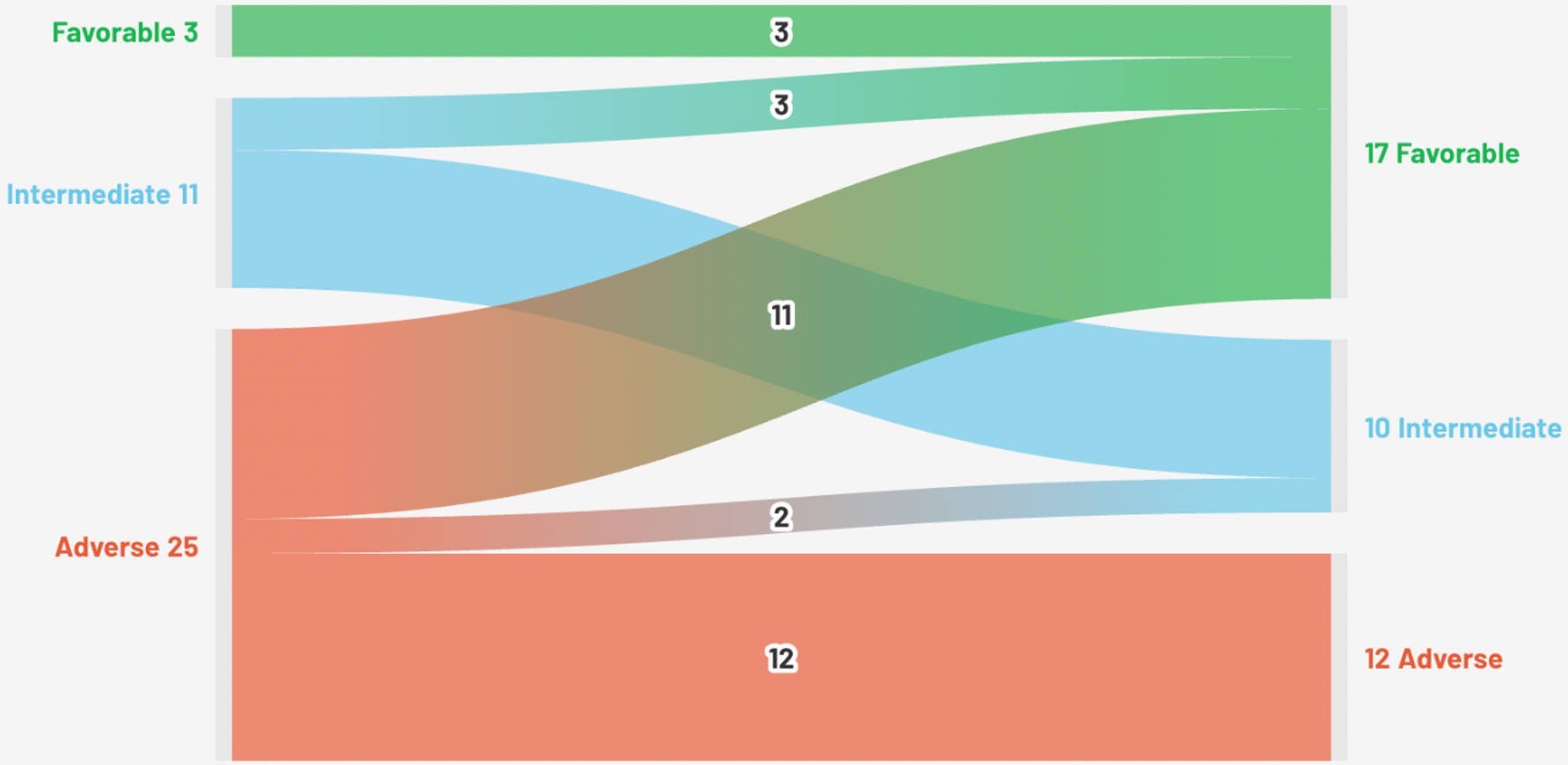
The redistribution of risk categories between ELN 2022 and ELN 2024 was summarized in Figure 2. Under ELN 2022, 3 patients were classified as favorable, 11 as intermediate, and 25 as adverse risk. In contrast, ELN 2024 categorized 17 patients as favorable, 10 as intermediate, and 12 as adverse risk. All patients classified as favorable by ELN 2022 remained favorable under ELN 2024. Among the 11 patients classified as intermediate risk according to ELN 2022, 8 (72.7%) remained in the intermediate category, whereas 3 (27.3%) were reclassified as favorable under ELN 2024. Importantly, among the 25 patients categorized as adverse risk by ELN 2022, only 12 (48%) remained adverse under ELN 2024, while 2 (8%) were reassigned to the intermediate category and 11 (44%) were reclassified as favorable (Figure 2).
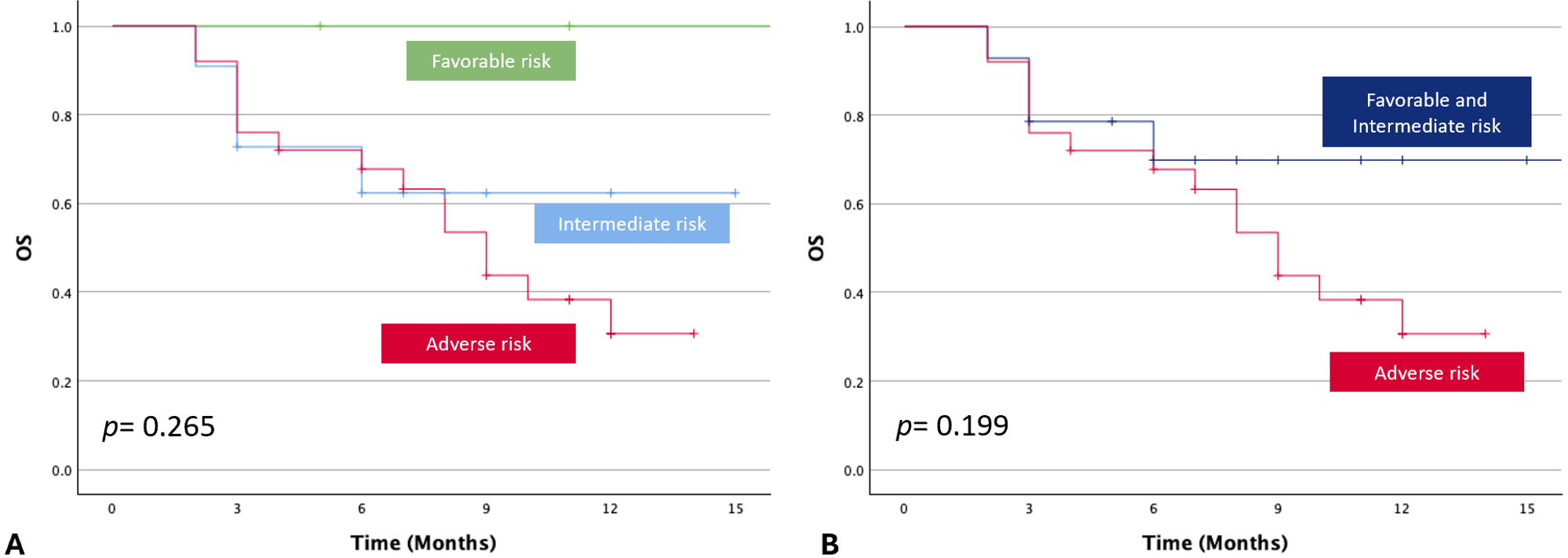
Kaplan–Meier survival analyses were performed according to both ELN 2022 and ELN 2024 risk classifications. Using the three-group ELN 2022 model (favorable, intermediate, adverse), no statistically significant difference in OS was observed among risk categories (log-rank p=0.265; Figure 3A). Similarly, when patients were dichotomized as favorable/intermediate versus adverse risk, ELN 2022 did not significantly stratify OS (log-rank p=0.199; Figure 3B). In contrast, ELN 2024 demonstrated improved risk discrimination. Although the three-group analysis did not reach statistical significance (log-rank p=0.125; Figure 4A), dichotomizing into favorable/intermediate versus adverse risk groups resulted in significant separation of the survival curves (log-rank p=0.041; Figure 4B).
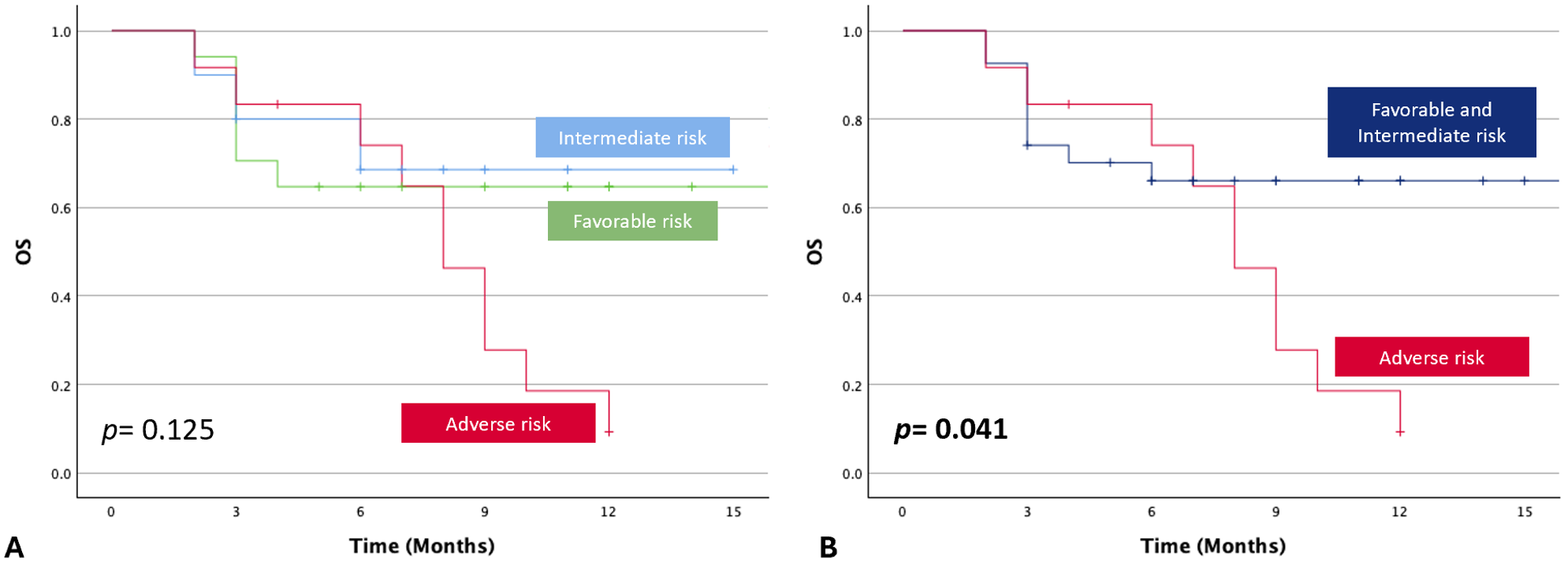
In Cox regression analysis, the adverse risk category according to ELN 2022 was not significantly associated with inferior OS compared with the favorable/intermediate risk categories (hazard ratio [HR] 1.98, 95% confidence interval [CI] 0.66–5.97; p=0.225). By contrast, the adverse risk category defined by ELN 2024 showed a stronger association with inferior OS (HR 2.41, 95% CI 0.98–5.94; p=0.057), demonstrating a near-significant trend toward worse survival.
Model discrimination was assessed using Harrell’s concordance index (C-index). The ELN 2022 model yielded a C-index of 0.613 (p=0.215; 95% CI, 0.434–0.792). A similar value was observed for the dichotomized ELN 2022 model (C-index 0.612; p=0.221). ELN 2024 showed improved discrimination with a C-index of 0.672 (p=0.051; 95% CI, 0.499–0.845). Notably, the highest discriminative performance was achieved with the dichotomized ELN 2024 model (C-index 0.697; p=0.021; 95% CI, 0.529–0.865), indicating superior prognostic accuracy compared with ELN 2022 (Supplementary Table 1).
When patients with prior azacitidine exposure or those who underwent allogeneic transplantation were excluded, the cohort size decreased; however, the overall direction and magnitude of the survival differences did not change materially (data not shown).
Discussion
In our real-world cohort of AML patients uniformly treated with azacitidine plus venetoclax, ELN 2024 showed improved prognostic discrimination compared with ELN 2022. Although three-group comparisons did not consistently reach statistical significance—likely due to the limited sample size—the directionality of results across Kaplan–Meier analyses, Cox regression, and concordance indices generally favored ELN 2024. Notably, the dichotomized ELN 2024 model (favorable/intermediate vs adverse) achieved significant survival separation and the highest discriminative capacity (C-index 0.697), providing preliminary support for its potential clinical utility in the venetoclax era.
AML outcomes vary substantially according to recurrent cytogenetic and molecular abnormalities. The ELN 2017 and 2022 classifications stratify patients into favorable, intermediate, and adverse risk groups based on these features. However, the derivation cohorts primarily consisted of younger patients treated with intensive chemotherapy, with or without allogeneic hematopoietic stem cell transplantation [4,5]. Consequently, ELN 2022 was not designed for patients receiving less-intensive regimens such as HMAs combined with venetoclax. Subsequent validation studies in older or unfit AML patients treated with HMAs with or without venetoclax demonstrated limited prognostic discrimination and an overrepresentation of patients within the adverse-risk category [4,6,9,10]. Such skewed allocation may reduce the clinical utility of ELN-based stratification as treatment paradigms shift toward venetoclax-based combinations in non-intensive settings.
In our cohort, ELN 2022 classified 64.1% of patients as adverse risk, whereas ELN 2024 reduced this proportion to 30.8%, with substantial redistribution to favorable and intermediate categories. This shift reflects the transition from therapy-agnostic risk assessment to treatment-context–specific stratification. By incorporating outcome data from HMA-based regimens, including HMA plus venetoclax and azacitidine combined with targeted agents, ELN 2024 recalibrates the prognostic weight of molecular abnormalities in the non-intensive setting [6,11]-13]. In particular, it emphasizes the dominant adverse impact of TP53 mutations while refining the classification of other molecular subgroups.
The biological rationale is supported by evidence showing that venetoclax-based regimens improve outcomes in NPM1-mutated AML—traditionally a favorable-risk subgroup—whereas TP53-mutated disease continues to carry a poor prognosis despite combination therapy ],14]-16]. In our cohort, TP53 mutations were present in 30.8% of patients, reflecting the high-risk molecular profile typical of older AML populations treated with non-intensive regimens. The improved discrimination observed with ELN 2024 may be related to more accurate risk allocation of these molecularly defined subgroups within the venetoclax-based treatment context [6].
When comparing our cohort with the pivotal VIALE-A trial, several differences become apparent [14]. In VIALE-A, 286 of 431 patients were assigned to azacitidine–venetoclax, with a median age of 76 years and a median OS of 14.7 months after 20.5 months of follow-up [14]. Prior exposure to HMAs, venetoclax, or chemotherapy for myelodysplastic syndrome was an exclusion criterion [14]. In contrast, 20.5% of our patients had prior azacitidine exposure, reflecting a less selected real-world population. The proportion of secondary AML was higher in our cohort (33.3% vs 25% in VIALE-A), and TP53 mutation frequency was also increased (30.8% vs 23% in the azacitidine–venetoclax arm) [14]. These adverse biological features likely contributed to the comparatively shorter survival observed in our study. Additionally, real-world factors—including a greater comorbidity burden, variability in supportive care, and treatment interruptions—may further explain differences in outcomes compared with a controlled trial setting. Together, these elements indicate that our cohort represents a more complex, higher-risk population, underscoring the importance of validating prognostic models in routine clinical practice.
Our study has several limitations that should be considered. The modest sample size and short median follow-up (7 months) restrict evaluation of long-term survival and preclude fully adjusted multivariable modeling. In addition, the single-center design, institutional testing practices, referral patterns, and transplant selection strategies may limit the generalizability of our findings. Nonetheless, the consistent directionality of survival separation and effect estimates across analytic methods supports the biological plausibility of ELN 2024 stratification in this context. Larger multicenter studies with longer follow-up are warranted to confirm these findings and further refine prognostic models, potentially integrating molecular risk with measurable residual disease (MRD) assessment to enhance risk prediction in the venetoclax era [17].
Conclusion
In this real-world Turkish AML cohort treated with azacitidine plus venetoclax, the ELN 2024 risk classification showed improved prognostic discrimination compared with ELN 2022. ELN 2024 more accurately redistributed patients across risk categories and achieved superior survival separation and concordance performance. These findings provide preliminary support for the potential clinical utility of treatment-context–specific risk stratification and reinforce the need for continued external validation of evolving genetic classification systems in contemporary AML practice. With larger patient cohorts and extended follow-up, future studies may enable the development and refinement of novel molecularly driven prognostic models tailored specifically to venetoclax-based treatment settings, potentially integrating genomic, clinical, and MRD parameters to further enhance risk prediction.
Ethical approval
This study was approved by the Ankara Etlik City Hospital Ethics Committee (Date: May 28, 2025, Decision/Protocol No: AEŞH-BADEK1-2025-086). Informed consent was obtained from all participants involved in this study.
Data availability statement
The data that support the findings of this study are available from the corresponding author upon reasonable request.
Conflict of interest
The authors declare that this study was conducted in the absence of any commercial or financial relationships that could be construed as a potential conflict of interest.
Funding
The authors declare that this study received no funding.
Generative AI statement
The authors declare that no generative AI or AI-assisted technologies were used in the writing or preparation of this study.
References
- Kucukyurt S, Eskazan AE. New drugs approved for acute myeloid leukaemia in 2018. Br J Clin Pharmacol 2019;85(12):2689-93. https://doi.org/10.1111/bcp.14105
- Pratz KW, Jonas BA, Pullarkat V, et al. Long-term follow-up of VIALE-A: venetoclax and azacitidine in chemotherapy-ineligible untreated acute myeloid leukemia. Am J Hematol 2024;99(4):615-24. https://doi.org/10.1002/ajh.27246
- Papaemmanuil E, Gerstung M, Bullinger L, et al. Genomic classification and prognosis in acute myeloid leukemia. N Engl J Med 2016;374(23):2209-21. https://doi.org/10.1056/NEJMoa1516192
- Döhner H, Wei AH, Appelbaum FR, et al. Diagnosis and management of AML in adults: 2022 recommendations from an international expert panel on behalf of the ELN. Blood 2022;140(12):1345-77. https://doi.org/10.1182/blood.2022016867
- Döhner H, Estey E, Grimwade D, et al. Diagnosis and management of AML in adults: 2017 ELN recommendations from an international expert panel. Blood 2017;129(4):424-47. https://doi.org/10.1182/blood-2016-08-733196
- Döhner H, DiNardo CD, Appelbaum FR, et al. Genetic risk classification for adults with AML receiving less-intensive therapies: the 2024 ELN recommendations. Blood 2024;144(21):2169-73. https://doi.org/10.1182/blood.2024025409
- Arber DA, Orazi A, Hasserjian RP, et al. International Consensus Classification of Myeloid Neoplasms and Acute Leukemias: integrating morphologic, clinical, and genomic data. Blood 2022;140(11):1200-28. https://doi.org/10.1182/blood.2022015850
- Khoury JD, Solary E, Abla O, Akkari YMN. The 5th edition of the World Health Organization Classification of Haematolymphoid Tumours: myeloid and histiocytic/dendritic neoplasms. Leukemia 2022;36(7):1703-19. https://doi.org/10.1038/s41375-022-01613-1
- Jahn E, Saadati M, Fenaux P, et al. Correction: clinical impact of the genomic landscape and leukemogenic trajectories in non-intensively treated elderly acute myeloid leukemia patients. Leukemia 2023;37(11):2336-37. https://doi.org/10.1038/s41375-023-02017-5
- Döhner H, Pratz KW, DiNardo CD, et al. Genetic risk stratification and outcomes among treatment-naive patients with AML treated with venetoclax and azacitidine. Blood 2024;144(21):2211-22. https://doi.org/10.1182/blood.2024024944
- Döhner H, Dolnik A, Tang L, et al. Cytogenetics and gene mutations influence survival in older patients with acute myeloid leukemia treated with azacitidine or conventional care. Leukemia 2018;32(12):2546-57. https://doi.org/10.1038/s41375-018-0257-z
- Montesinos P, Recher C, Vives S, et al. Ivosidenib and azacitidine in <i>IDH1</i>-mutated acute myeloid leukemia. N Engl J Med 2022;386(16):1519-31. https://doi.org/10.1056/NEJMoa2117344
- Pollyea DA, Pratz KW, Wei AH, et al. Outcomes in patients with poor-risk cytogenetics with or without tp53 mutations treated with venetoclax and azacitidine. Clin Cancer Res 2022;28(24):5272-9. https://doi.org/10.1158/1078-0432.CCR-22-1183
- DiNardo CD, Jonas BA, Pullarkat V, et al. Azacitidine and venetoclax in previously untreated acute myeloid leukemia. N Engl J Med 2020;383(7):617-29. https://doi.org/10.1056/NEJMoa2012971
- Lachowiez CA, Loghavi S, Kadia TM, et al. Outcomes of older patients with NPM1-mutated AML: current treatments and the promise of venetoclax-based regimens. Blood Adv 2020;4(7):1311-20. https://doi.org/10.1182/bloodadvances.2019001267
- Tiong IS, Dillon R, Ivey A, et al. Venetoclax induces rapid elimination of NPM1 mutant measurable residual disease in combination with low-intensity chemotherapy in acute myeloid leukaemia. Br J Haematol 2021;192(6):1026-30. https://doi.org/10.1111/bjh.16722
- Wei AH, Iland HJ, DiNardo CD, Reynolds J. Measurable residual disease intervention in AML: a new therapeutic horizon. Blood 2026;147(1):13-23. https://doi.org/10.1182/blood.2025029010
Copyright and License
Copyright © 2026 The Author(s). This is an open access article distributed under the Creative Commons Attribution License (CC BY), which permits unrestricted use, distribution, and reproduction in any medium or format, provided the original work is properly cited.