

Abstract
Objectives: Physical activity’s impact on oxidant production and defense systems varies based on its level, duration, and intensity. This research examines lipid oxidation, protein oxidation, and thiol-based antioxidant defense markers in the blood of amateur soccer players and sedentary men.
Methods: In this cross-sectional study, we assessed 24 healthy sedentary men and 21 amateur male football players. Serum levels of malondialdehyde (MDA), total thiol, and advanced oxidation protein products (AOPP) were measured and adjusted for protein content.
Results: Football players had non-significantly lower MDA levels than sedentary controls, indicating a descriptive trend towards reduced lipid peroxidation (p = 0.0614). Non-significantly lower AOPP levels were also observed in the football group (p = 0.2023), suggesting a descriptive trend towards reduced protein oxidation. Football players had slightly but non-significantly higher total thiol levels (p = 0.3337), indicating a possible trend towards increased thiol-based antioxidant capacity. In conclusion, these findings suggest that individuals who exercise regularly may have a more favourable redox profile, although the differences did not reach statistical significance.
Conclusion: The oxidative stress profile of amateur football players showed favorable but statistically non-significant trends compared with sedentary men. The combined serum levels of MDA, AOPP, and total thiol suggest that regular football training may be associated with positive changes in redox balance; however, these findings should be interpreted with caution as the differences did not reach statistical significance.
Keywords: football, oxidative stress, malondialdehyde, advanced oxidation protein products, total thiol
Introduction
Oxidative stress is a biological imbalance that arises when the body generates more reactive oxygen species than its antioxidant systems can manage. Reactive oxygen species are essential for cell communication and adaptability, but excessive amounts can damage cells [1]. This redox imbalance has been linked to the pathophysiology of numerous chronic illnesses, including diabetes, metabolic dysfunction, neurodegenerative diseases, and cardiovascular diseases [2]. Therefore, assessing biomarkers related to oxidative stress is essential in disease states and in physiological situations that may alter redox homeostasis, such as regular exercise.
Exercise is a recognised physiological factor that influences the oxidant-antioxidant balance in a complex manner dependent on intensity. Intense exercise may temporarily increase reactive oxygen species due to heightened oxygen intake, mitochondrial activity, and the metabolic demands of muscle contractions [2]. However, regular and optimised physical activity can improve the body’s antioxidant systems and reduce baseline oxidative stress [3]. This adaptive response is often attributed to repeated moderate oxidative stressors that strengthen cellular defences against future oxidative stress, a process known as exercise-induced hormesis [3]. The direction and magnitude of this response can vary depending on the type of exercise, training duration, fitness level, and individual biological characteristics [4].
Football requires significant aerobic and anaerobic energy expenditure, frequent sprints, rapid changes of direction, and periods of intense running. Football players are an appropriate group for studying exercise-induced redox alterations due to their physiological characteristics [5]. Previous research suggests that football activity, oxidative stress, and antioxidant status may be related, particularly during matches or intense training sessions [5,6]. However, as amateur football players often have more varied training, recovery periods, diet, and lifestyle outside the sport, they may differ from professional athletes. Thus, measuring oxidative stress markers in amateur football players may provide valuable information on the biochemical effects of regular training under real sporting conditions.
Malondialdehyde (MDA) is a common marker of lipid peroxidation, indicating oxidative damage within cellular membranes [7]. Compared to lipid markers, advanced oxidation protein products (AOPP) reflect oxidative changes in proteins and may provide additional information [8]. Total thiol groups, mainly derived from molecules with sulfhydryl groups such as glutathione and protein thiols, are a reliable indicator of endogenous antioxidant potential [9]. By considering lipid, protein, and thiol-dependent antioxidant defences, these three markers together may provide a more comprehensive assessment of oxidative status.
Most previous research on sports-related oxidative stress has focused on markers of lipid peroxidation or selected antioxidant enzymes [4,10,11]. There has been less emphasis on AOPP and thiol-based antioxidant parameters in amateur football players compared to other research areas. This gap is significant because training may affect different aspects of redox balance in distinct ways. Assessing MDA, AOPP, and total thiol levels together may show whether regular football training is associated with a more favorable oxidative status.
In this context, the present study aimed to compare serum oxidative stress biomarkers in age-matched sedentary males and amateur male football players. We proposed that amateur football players show lower oxidative damage markers, as indicated by MDA and AOPP levels, and higher antioxidant capacity, as indicated by total thiol levels, compared to sedentary individuals. This study aims to advance understanding of long-term exercise-related biochemical changes in amateur athletes by analyzing these characteristics collectively.
Materials and Methods
Study design and participants
This study involved 45 males, divided into two groups. Twenty-one amateur male football players, who had competed in amateur leagues over the past year and maintained consistent training, comprised the football players group. The football players had regular training during the previous year; however, detailed quantitative training variables, such as weekly training duration, intensity, and total training load, were not available for all participants. The control group consisted of 24 healthy male university students from Muğla Sıtkı Koçman University who were sedentary and had not exercised regularly in the previous six months. The International Physical Activity Questionnaire’s short form (IPAQ-SF) was used to confirm sedentary status, and only those meeting the criteria for physical inactivity were included in the control group [12].
Before sample collection, all participants were informed about the study procedures and provided written consent. The study protocol was approved by the Muğla Sıtkı Koçman University Medical and Health Sciences Research Ethics Committee (Protocol No: 250140/29). To ensure that recent physical exertion did not affect oxidative stress markers, blood samples were collected at rest, at least 24 hours after any exercise.
Blood collection and serum preparation
Eight millilitres of venous blood were collected from each participant at noon and placed in a plain, anticoagulant-free tube. Fasting before sampling was not required. As recent dietary intake may influence circulating redox markers, the non-fasting sampling condition was considered when interpreting the findings and was noted as a study limitation. Serum was separated from the blood samples by centrifugation at 1500 × g within 30 minutes of collection. Serum samples were aliquoted into Eppendorf tubes and stored at −80°C until biochemical analysis. Each biochemical measurement was performed in technical triplicate for each sample.
Determination of malondialdehyde levels
A TBARS-based commercial kit (Cayman, Cat. No: 10009055) was used to measure serum malondialdehyde (MDA) [13]. In short, serum samples and standards were treated with thiobarbituric acid reagent. The reaction mixture was then incubated for 60 minutes at 95–100°C. The reaction was stopped on ice for 5 minutes, and the tubes were centrifuged at 1600 × g for 10 minutes to separate the supernatant. After transferring the supernatant to 96-well microplates, absorbance was measured at 530 nm. MDA concentrations were calculated and expressed in μmol/L, using a linear standard curve.
Determination of total thiol levels
Total thiol levels in serum were measured using Ellman’s reagent, 5,5′-dithiobis-(2-nitrobenzoic acid) (DTNB), following established spectrophotometric methods [14,15]. First, serum samples were mixed with DTNB reagent and kept in the dark at room temperature for 15 minutes. Absorbance was then measured at 412 nm. Total thiol concentrations were determined using a glutathione standard curve and are reported in μmol/L.
Determination of advanced oxidation protein products
Advanced oxidation protein products (AOPP) were quantified according to the procedure described by Witko-Sarsat et al.[8]. After dilution of serum samples with potassium phosphate buffer, potassium iodide and acetic acid were added. Absorbance of the reaction mixture was measured at 340 nm using a spectrophotometer. AOPP levels were quantified using a chloramine-T standard curve and reported as μmol/L chloramine-T equivalents.
Determination of total protein levels
A bicinchoninic acid (BCA) protein assay kit, based on the microplate method, was used to measure total protein concentration [16]. Absorbance was measured at 562 nm after incubating appropriately diluted serum samples and bovine serum albumin standards with BCA reagent. Total protein was used for normalization in biochemical analysis.
Statistical analysis
GraphPad Prism version 9 was used for statistical analyses. The Shapiro–Wilk test was used to evaluate the distribution of continuous variables. The Mann–Whitney U test was applied to non-normally distributed data, and Welch’s independent samples t-test was used for normally distributed data. Data are presented as mean ± SD (standard deviation). As detailed quantitative training variables, such as weekly training duration, intensity, or training load, were not available for all participants, correlation analysis between training variables and biochemical markers was not performed. A p value less than 0.05 was considered statistically significant. Effect size calculations, including Cohen’s d where appropriate, supported the assessment of group differences.
Results
A total of 45 males participated in the study, consisting of 21 amateur football players and 24 sedentary individuals. Three biochemical markers were examined to quantify resting oxidative stress: total thiol levels, AOPP, and MDA. A consistent pattern was observed between the groups when these parameters were analyzed. Oxidative damage markers were generally lower, and antioxidant thiol levels were slightly higher, in football players compared to sedentary individuals.
The IPAQ-SF was used to confirm the physical activity status of the control participants before group assignment. The IPAQ-SF evaluation showed that participants in the sedentary control group were physically inactive and had not exercised regularly in the past six months. The questionnaire findings validated the intended division between the physically active football group and the sedentary control group. This confirmation reinforced the validity of the group comparison by minimizing the likelihood that regularly active individuals were included in the sedentary controls.
Demographic and anthropometric characteristics of the study subjects were also evaluated (Table 1). The BMI of the sedentary group was significantly higher than that of the football players (p<0.0001). Football players had a leaner body composition, with a mean BMI of 21.8 ± 1.30 kg/m², compared to the sedentary group’s mean BMI of 26.4 ± 3.81 kg/m². The age distributions of the groups were similar (p = 0.1376). The mean age was 21.9 ± 2.32 years for the sedentary group and 20.9 ± 3.80 years for the football player group. These results indicate that the groups were largely similar in age, with BMI differences reflecting the expected physical profiles of regularly trained football players.
| Table 1. Demographic and anthropometric characteristics of the study groups. | ||||
| Variable |
|
|
|
|
| BMI | Min-Max |
|
|
|
| Median±SEM |
|
|
||
| Mean±SD |
|
|
||
| Age | Min-Max |
|
|
|
| Median±SEM |
|
|
||
| Mean±SD |
|
|
||
| Data are presented as mean ± SD. Between-group comparisons were performed using the independent samples Welch's t test according to data distribution. BMI: body mass index; SEM: standard error of the mean; SD: standard deviation. | ||||
Compared with the sedentary control group, the football player group had non-significantly lower MDA levels, which indicate lipid peroxidation (Figure 1).
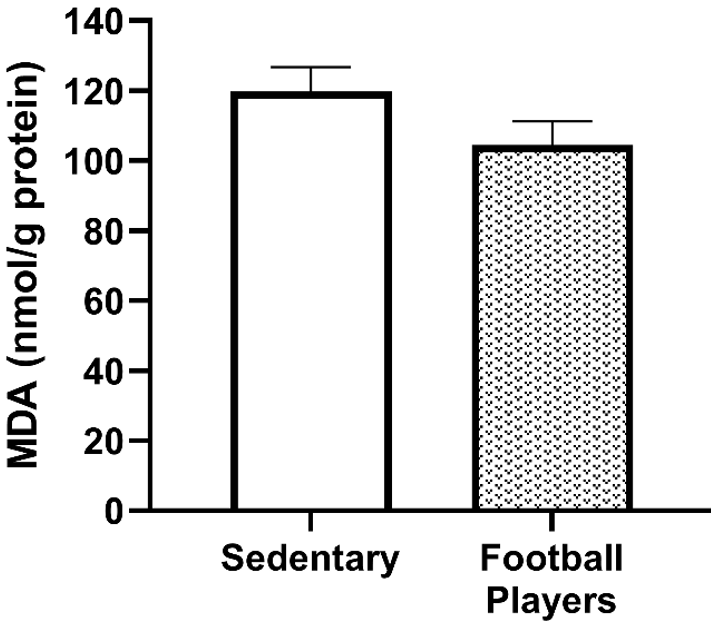
Sedentary individuals had a mean MDA value of 120 nmol/g protein, while football players had a mean value of 105 nmol/g protein. The football group showed a clear downward trend, although this did not reach statistical significance (p = 0.0614). The data suggest that amateur footballers may show a trend towards lower lipid peroxidation than sedentary men.
Football players also had non-significantly lower AOPP levels than sedentary individuals (Figure 2).
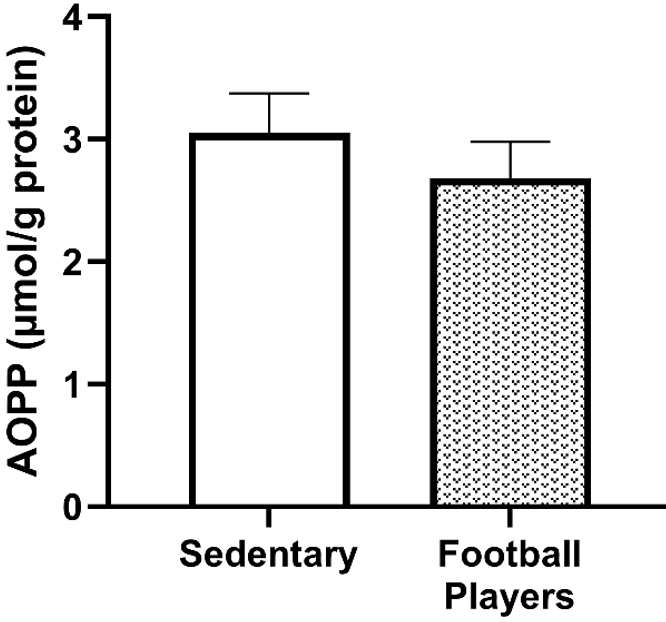
In the football group, the mean AOPP concentration was 2.68 µmol/g protein, compared to 3.05 µmol/g protein in the sedentary group. Although this difference was not statistically significant (p = 0.2023), the study suggests that football players tended to have lower levels of protein oxidative modification.
Total thiol levels in football players were slightly higher, in contrast to the oxidative damage markers (Figure 3).
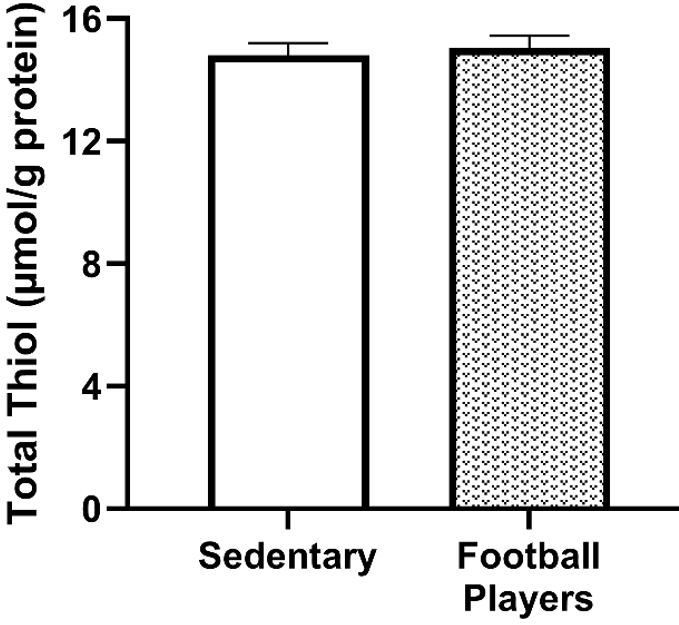
The mean total thiol level for football players was 15.1 µmol/g protein, while the sedentary group had a mean of 14.8 µmol/g protein. The football group exhibited slightly higher thiol-dependent antioxidant capacity, although this was not significant (p = 0.3337). The combination of lower MDA and AOPP levels and higher total thiol levels suggests that amateur football players may have a more favorable resting redox profile than inactive individuals. However, the data should be presented as a consistent descriptive trend rather than as statistically verified group differences, as no single comparison was statistically significant.
Discussion
The present results suggest that consistent football training may be associated with favorable trends in the biological balance of oxidants and antioxidants. This conclusion is significant because football is known to induce acute oxidative stress during competition and intense training [17]. Antioxidants can lessen the first increase in TBARS/MDA that usually occurs after competitive or hard exercise [5]. Thus, long-term adaptation and acute oxidative stress are different phases of a single physiological response rather than opposing theories [6,18].
Human studies indicate that regular training may reduce resting lipid peroxidation, which is consistent with the non-significantly lower MDA levels observed in the football group. Previous research has reported that professional footballers have lower serum MDA compared with sedentary individuals [19]. Another study found that, compared to sedentary men, football players had higher total antioxidant status and lower oxidative stress index [20]. In a parallel study, football players showed lower lipid hydroperoxide and higher paraoxonase activity, demonstrating reduced oxidative stress in trained individuals [21]. In line with our MDA findings, these results suggest that regular football training may contribute to redox control; however, our findings should be interpreted with caution because the MDA difference did not reach statistical significance.
In sport studies, protein oxidation is less frequently studied than lipid oxidation, so the AOPP result provides valuable information. We found that football players exhibited non-significantly lower AOPP values, suggesting that possible redox adaptation may not be limited to lipids. This is important, as oxidative marker findings in exercise studies are frequently inconsistent. Previous research reported that intermittent jogging increased MDA but not AOPP, indicating that protein oxidation responds more slowly to short-term exercise than lipid peroxidation [18]. Another key study reported that endurance-trained athletes showed reduced AOPP compared to strength-trained athletes, with sedentary individuals exhibiting intermediate levels [22]. This suggests that different training techniques may influence protein oxidation. Another study found that AOPP did not differ between elite sports groups, even when variations in MDA were present [11]. Together with previous studies, our AOPP results suggest a possible non-significant trend towards lower protein oxidation in football players, likely influenced by sport type and training intensity.
In this study, the slightly elevated but non-significant total thiol concentration in football players may be important, as thiol-containing compounds serve as an important extracellular antioxidant buffer. Previous research reported that frequent exercisers had greater total thiol levels than inactive participants [23]. Recent football research has shown a strong correlation between training load and thiol oxidation, indicating that thiol biology is highly responsive to exercise [24]. According to the available data, the football group exhibited a possible favorable redox trend, with slightly higher antioxidant defence markers and lower oxidative damage markers; however, this interpretation should be made cautiously, as the differences were not statistically significant.
On the other hand, there are also contrary studies. A study observed reduced erythrocyte MDA in football players compared to sedentary men [25]. However, they concluded that the athletes experienced higher oxidative stress due to lower levels of several antioxidant vitamins in that group. Similarly, Watson et al. found that inactive controls and trained athletes did not differ in a few resting oxidative stress indicators [26]. These differences are not unexpected. Results of oxidative stress are inconsistent due to variations in biological material, chosen marker, prior exercise, nutritional state, training volume for professionals and amateurs, and sample timing (during competition, recovery, or rest). Despite these results, the current dataset is internally consistent: slightly higher total thiol, lower AOPP, and lower MDA all showed the same non-significant descriptive trend. Overall, the most supportable conclusion is that consistent football training in this group may be associated with a more favorable resting redox profile compared to a sedentary lifestyle, although this should be confirmed in larger and better-controlled studies.
Future perspectives
Prospective research is needed to examine this pattern by tracking players during the preseason, the season, and their recovery. Frequent sampling may allow researchers to distinguish between temporary changes caused by match pressure or increased training adaptations. Including more enzymatic antioxidants and thiol/disulphide homeostasis indicators, such as total glutathione, in the redox panel would also be beneficial. Tracking dietary intake, body composition, aerobic fitness, sleep, and inflammatory markers may provide further valuable information. This approach would evaluate whether the current favorable descriptive trend continues throughout the season or changes with increased training intensity, as suggested by studies on training load and match recovery [5,24].
Ethical approval
This study was approved by the Muğla Sıtkı Koçman University Medical and Health Sciences Research Ethics Committee (Date: January 27, 2026, Decision/Protocol No: 250140/29). Informed consent was obtained from all participants involved in this study.
Data availability statement
The data that support the findings of this study are available from the corresponding author upon reasonable request.
Conflict of interest
The authors declare that this study was conducted in the absence of any commercial or financial relationships that could be construed as a potential conflict of interest.
Funding
The authors declare that this study received no funding.
Acknowledgements
The authors would like to thank Ali Akbaş and Volkan Dizman for their valuable support and contributions during the study.
Generative AI statement
The authors declare that during the preparation of this study, the following AI-assisted technology was used: Not specified in the manuscript. Extent of Use: Generative AI or AI-assisted technologies were used solely for English language editing and improving the clarity of the manuscript. The authors confirm that they have critically reviewed and edited any AI-generated content and take full responsibility for the integrity, accuracy, and originality of the publication. The authors certify that the original human contribution is maintained and that AI-assisted tools are not listed or cited as authors.
References
- Sies H. Oxidative stress: concept and some practical aspects. Antioxidants (Basel) 2020;9(9):852. https://doi.org/10.3390/antiox9090852
- Pizzino G, Irrera N, Cucinotta M, et al. Oxidative stress: harms and benefits for human health. Oxid Med Cell Longev 2017;2017:8416763. https://doi.org/10.1155/2017/8416763
- Radak Z, Chung HY, Koltai E, Taylor AW, Goto S. Exercise, oxidative stress and hormesis. Ageing Res Rev 2008;7(1):34-42. https://doi.org/10.1016/j.arr.2007.04.004
- Powers SK, Duarte J, Kavazis AN, Talbert EE. Reactive oxygen species are signalling molecules for skeletal muscle adaptation. Exp Physiol 2010;95(1):1-9. https://doi.org/10.1113/expphysiol.2009.050526
- Fatouros IG, Chatzinikolaou A, Douroudos II, et al. Time-course of changes in oxidative stress and antioxidant status responses following a soccer game. J Strength Cond Res 2010;24(12):3278-86. https://doi.org/10.1519/JSC.0b013e3181b60444
- de Oliveira DCX, Rosa FT, Simões-Ambrósio L, Jordao AA, Deminice R. Antioxidant vitamin supplementation prevents oxidative stress but does not enhance performance in young football athletes. Nutrition 2019;63-64:29-35. https://doi.org/10.1016/j.nut.2019.01.007
- Ayala A, Muñoz MF, Argüelles S. Lipid peroxidation: production, metabolism, and signaling mechanisms of malondialdehyde and 4-hydroxy-2-nonenal. Oxid Med Cell Longev 2014;2014:360438. https://doi.org/10.1155/2014/360438
- Witko-Sarsat V, Friedlander M, Capeillère-Blandin C, et al. Advanced oxidation protein products as a novel marker of oxidative stress in uremia. Kidney Int 1996;49(5):1304-13. https://doi.org/10.1038/ki.1996.186
- Turell L, Radi R, Alvarez B. The thiol pool in human plasma: the central contribution of albumin to redox processes. Free Radic Biol Med 2013;65:44-253. https://doi.org/10.1016/j.freeradbiomed.2013.05.050
- Hammouda O, Chtourou H, Chaouachi A et al. Effect of short-term maximal exercise on biochemical markers of muscle damage, total antioxidant status, and homocysteine levels in football players. Asian J Sports Med 2012;3(4):239-46. https://doi.org/10.5812/asjsm.34544
- Hadžović-Džuvo A, Valjevac A, Lepara O, Pjanić S, Hadžimuratović A, Mekić A. Oxidative stress status in elite athletes engaged in different sport disciplines. Bosn J Basic Med Sci 2014;14(2):56-62. https://doi.org/10.17305/bjbms.2014.2262
- Craig CL, Marshall AL, Sjöström M, et al. International physical activity questionnaire: 12-country reliability and validity. Med Sci Sports Exerc 2003;35(8):1381-95. https://doi.org/10.1249/01.MSS.0000078924.61453.FB
- Ohkawa H, Ohishi N, Yagi K. Assay for lipid peroxides in animal tissues by thiobarbituric acid reaction. Anal Biochem 1979;95(2):351-8. https://doi.org/10.1016/0003-2697(79)90738-3
- Hu ML. Measurement of protein thiol groups and glutathione in plasma. Methods Enzymol 1994;233:380-5. https://doi.org/10.1016/s0076-6879(94)33044-1
- Taylan E, Resmi H. The analytical performance of a microplate method for total sulfhydryl measurement in biological samples. Turk J Biochem 2010;35(3):275-8.
- Smith PK, Krohn RI, Hermanson GT, et al. Measurement of protein using bicinchoninic acid. Anal Biochem 1985;150(1):76-85. https://doi.org/10.1016/0003-2697(85)90442-7
- Tauler P, Ferrer MD, Sureda A, et al. Supplementation with an antioxidant cocktail containing coenzyme Q prevents plasma oxidative damage induced by soccer. Eur J Appl Physiol 2008;104(5):777-85. https://doi.org/10.1007/s00421-008-0831-6
- Souissi W, Bouzid MA, Farjallah MA, et al. Effect of different running exercise modalities on post-exercise oxidative stress markers in trained athletes. Int J Environ Res Public Health 2020;17(10):3729. https://doi.org/10.3390/ijerph17103729
- Zanella AM, Nakazone MA, Pinhel MAS, Souza DRS. Lipid profile, apolipoprotein A-I and oxidative stress in professional footballers, sedentary individuals, and their relatives. Arq Bras Endocrinol Metabol 2011;55(2):121-6. https://doi.org/10.1590/S0004-27302011000200004
- Atli M, Aslan M, Emin Kucukoglu M, Temur HB, Taskin A, Celik H. Peripheral lymphocyte DNA damage and oxidative status in football players after a three-day football tournament. Intern Med 2013;52(2):213-7. https://doi.org/10.2169/internalmedicine.52.7861
- Atli M. Serum paraoxonase activity and lipid hydroperoxide levels in adult football players after three days football tournament. Afr Health Sci 2013;13(3):565-71. https://doi.org/10.4314/ahs.v13i3.6
- Choi Y, Maeda S, Otsuki T, Miyaki A, Shimojo N, Yoshizawa M, et al. Oxidative stress and arterial stiffness in strength- and endurance-trained athletes. Artery Res 2010;4(2):52-8. https://doi.org/10.1016/j.artres.2010.04.002
- Gol M, Özkaya B, Yildirim C, Bal R. Regular exercise, overweight/obesity and sedentary lifestyle cause adaptive changes in thiol-disulfide homeostasis. An Acad Bras Cienc 2019;91(2):e20180547. https://doi.org/10.1590/0001-3765201920180547
- James C, Weber J, Boyd C, Fournier PA, Arthur PG. The thiol oxidation state of albumin is associated with training load across an Australian football pre-season. Oxid Med Cell Longev 2026;2026(1):e5534194. https://doi.org/10.1155/omcl/5534194
- Siquier-Coll J, Muñoz Marín D, Grijota Pérez FJ, et al. Influence of soccer training on parameters of oxidative stress in erythrocytes. Nutr Hosp 2019;36(4):926-30.
- Watson TA, MacDonald-Wicks LK, Garg ML. Oxidative stress and antioxidants in athletes undertaking regular exercise training. Int J Sport Nutr Exerc Metab 2005;15(2):131-46. https://doi.org/10.1123/ijsnem.15.2.131
Copyright and License
Copyright © 2026 The Author(s). This is an open access article distributed under the Creative Commons Attribution License (CC BY), which permits unrestricted use, distribution, and reproduction in any medium or format, provided the original work is properly cited.