

Abstract
Objective: Improvements in survival have led to a growing adult population with cystic fibrosis (CF), increasing the relevance of intensive care unit (ICU) management in this group. However, nationwide data on ICU utilization and outcomes in CF remain limited.
Materials and Methods: This nationwide retrospective cohort study included all adults (≥18 years) with CF admitted to ICUs in Türkiye between 2018 and 2023. Data were obtained from the Turkish Ministry of Health National Electronic Database, covering all ICU levels and hospital types. Demographic characteristics, admission diagnoses, comorbidities, ICU interventions, APACHE II scores, and outcomes were analyzed. The primary outcome was ICU mortality.
Results: A total of 126 adults with CF were admitted to ICUs during the study period. Most admissions occurred in Level 3 ICUs (62.7%) and mixed ICUs (38.8%). More than half were concentrated in the Marmara region (50.8%). Median age was 30 years [23–41], and overall ICU mortality was 32.5%. Non-survivors were older and had higher APACHE II scores than survivors (21 [12–28] vs. 7 [3–13], p<0.01). Sepsis was more frequent among non-survivors (31.7% vs. 15.3%, p=0.03), and cardiovascular comorbidities were associated with mortality. Non-invasive mechanical ventilation was commonly used but was not associated with ICU mortality.
Conclusions: In this nationwide cohort, ICU mortality among adults with CF was comparable to contemporary international reports and was primarily associated with acute illness severity and infectious complications. These findings provide the first national overview of ICU care in CF in Türkiye and highlight the importance of severity-based risk stratification in critically ill adults with CF.
Keywords: adult, acute respiratory failure, critical care outcomes, critical illness, cystic fibrosis, mechanical ventilation, mortality
Introduction
Cystic fibrosis (CF) is a multisystem genetic disorder characterized by chronic pulmonary disease, recurrent infections, and progressive organ dysfunction [1]. Advances in respiratory care, antimicrobial therapy, and multidisciplinary follow-up have substantially improved survival, leading to an increasing number of adult patients living with CF [2,3]. This demographic shift is particularly evident in established national registries; in the United States, adults accounted for 61.6% of individuals included in the Cystic Fibrosis Foundation Patient Registry in 2024 [4]. A similar transition is emerging in Türkiye. According to the Cystic Fibrosis Registry of Türkiye, 2,258 patients were registered in 2023, of whom 336 (14.9%) were aged ≥18 years, compared with only nine registered adult patients in 2016 [5]. As the number of adults living with CF increases, understanding the patterns and outcomes of critical illness in this population becomes increasingly relevant. Advances in respiratory care, antimicrobial therapy, modulator treatment, and multidisciplinary follow-up have substantially improved survival, resulting in a growing population of adults living with CF. Although these advances may reduce hospitalization and intensive care utilization in some patients, adults with CF may still develop critical illness due to acute respiratory failure, severe infection, or complications of advanced multisystem disease. Therefore, as the adult CF population expands, understanding the characteristics and outcomes of those who require intensive care remains clinically relevant [6,7].
The management of critically ill patients with CF poses unique challenges. These patients frequently present with advanced lung disease, chronic colonization with multidrug-resistant pathogens, nutritional impairment, and extrapulmonary organ involvement, all of which may adversely affect ICU outcomes [8,9]. Previous studies from high-income countries have reported variable ICU mortality rates in CF, influenced by disease severity, age, and the presence of acute complications [10,11]. However, most available data originate from single-center cohorts or national registries in high-income settings, limiting the generalizability of findings to countries with different healthcare system structures [12]. Despite this extensive ICU infrastructure, nationwide data on the characteristics, distribution, and outcomes of critically ill patients with CF are scarce. In particular, little is known about where patients with CF receive intensive care, how ICU admissions are geographically distributed, and which clinical factors are associated with ICU mortality at the national level.
Therefore, the aim of this study was to provide the first nationwide descriptive analysis of ICU admissions among patients with cystic fibrosis in Türkiye over a six-year period. We sought to characterize the types and levels of ICUs to which patients with CF are admitted, to describe the geographic distribution of ICU admissions, and to compare clinical characteristics and outcomes between ICU survivors and non-survivors.
Materials and Methods
Study design and data source
This nationwide retrospective cohort study analyzed ICU admissions of adult patients with CF in Türkiye between January 1, 2018, and December 31, 2023. Data were retrieved from the Turkish Ministry of Health National Electronic Database, which prospectively collects administrative and clinical information from all public, university, and private hospitals across the country. Adult patients with cystic fibrosis were identified using ICD-10 code E84 and all of its subcategories recorded in the national database. Admission diagnoses and comorbid conditions were similarly identified using predefined ICD-10 codes. Admission diagnoses and comorbid conditions were similarly identified using predefined ICD-10 codes.
For each eligible patient, demographic characteristics, ICU admission data, primary admission diagnoses, comorbidities, ICU interventions, APACHE II scores, and ICU outcomes were extracted from the national database. The ICD-10 codes used for cystic fibrosis, admission diagnoses, and comorbid conditions are provided in Table 1.
| ICD-10, International Classification of Diseases, 10th Revision. Diagnostic categories include the listed parent codes and their corresponding subcategories unless otherwise specified. | |
| Table 1. ICD-10 codes used for identification of cystic fibrosis, admission diagnoses, and comorbidities. | |
| Variable | ICD-10 code(s) |
| Cystic fibrosis | E84 and all subcategories |
| Respiratory failure | J96 and subcategories |
| Sepsis | A40–A41 and subcategories |
| Pulmonary embolism | I26 and subcategories |
| Acute kidney injury | N17 and subcategories |
| Liver failure | K72 and subcategories |
| Cerebrovascular disease | I60–I69 |
| Gastrointestinal hemorrhage | K92.0–K92.2 |
| Hypertension | I10–I15 |
| Diabetes mellitus | E10–E14 |
| Coronary artery disease | I20–I25 |
| Heart failure | I50 and subcategories |
| Chronic kidney disease | N18 and subcategories |
Study population
Adult patients (≥18 years) with a diagnosis of cystic fibrosis who were admitted to an ICU between January 1, 2018, and December 31, 2023, were included. Cystic fibrosis was identified using ICD-10 code E84 and all corresponding subcategories. All ICU admissions meeting these criteria were included in the study. The unit of analysis was the individual patient, and the final cohort consisted of 126 unique adult patients with cystic fibrosis who were admitted to an ICU during the study period.
ICU characteristics and classification
ICUs were categorized as Level 1, Level 2, or Level 3 according to national regulatory definitions, which are based on staffing, monitoring capabilities, and the complexity of organ support that can be provided. ICU types were classified as mixed, anesthesiology, pulmonary, medical, surgical, and other specialized units. Information regarding the availability of each ICU level at individual hospitals was not available in the national dataset.
Variables and outcomes
Demographic characteristics (age and sex), primary admission diagnoses, comorbid conditions, and ICU interventions—including non-invasive mechanical ventilation (NIMV), continuous renal replacement therapy (CRRT), and tracheotomy—were recorded. Disease severity was assessed using the Acute Physiology and Chronic Health Evaluation II (APACHE II) score at ICU admission. The primary outcome was ICU mortality. Secondary outcomes included ICU length of stay and the distribution of ICU admissions by region, ICU type, and care level.
Statistical analysis
Continuous variables were assessed for normality using the Kolmogorov–Smirnov test and are presented as medians with interquartile ranges (25th–75th percentiles). Categorical variables are summarized as frequencies and percentages. Comparisons between ICU survivors and non-survivors were performed using the Mann–Whitney U test for continuous variables and the chi-square test for categorical variables, as appropriate. All statistical tests were two-sided, and a p value <0.05 was considered statistically significant. Statistical analyses were conducted using IBM SPSS Statistics for Windows, version 23.0 (IBM Corp., Armonk, NY, USA).
This study was conducted in accordance with the principles of the Declaration of Helsinki. The analysis was based on anonymized, routinely collected national registry data, and individual patient consent was not required. The study protocol was approved by the Republic of Türkiye Ministry of Health with the approval number 95741342-020.
Results
ICU admissions and unit characteristics
Between 2018 and 2023, a total of 126 adult patients with cystic fibrosis were admitted to ICUs nationwide. Annual admissions ranged from 14 cases in 2018 and 2019 to 27 cases in 2020. No admissions occurred in Level 1 ICUs during the study period. Overall, 79 admissions (62.7%) were managed in Level 3 ICUs and 47 (37.3%) in Level 2 ICUs. Over time, admissions increasingly concentrated in Level 3 units. Regarding ICU type, mixed ICUs accounted for the largest proportion of admissions (38.8%), followed by anesthesiology ICUs (18.3%), pulmonary ICUs (13.5%), and medical ICUs (11.1%). Other specialized ICUs represented a small proportion of admissions (Table 2).
| ICU: intensive care unit, CF: cystic fibrosis | |||||||
| Table 2. Characteristics of intensive care units to which patients with CF were admitted. | |||||||
|
Year n (%) |
|
|
|
|
|
|
|
| Level of ICU | |||||||
| Level 1 |
|
|
|
|
|
|
|
| Level 2 |
|
|
|
|
|
|
|
| Level 3 |
|
|
|
|
|
|
|
| ICU Type | |||||||
| Mixed |
|
|
|
|
|
|
|
| Anesthesiology |
|
|
|
|
|
|
|
| Pulmonary |
|
|
|
|
|
|
|
| Medical |
|
|
|
|
|
|
|
| Surgical |
|
|
|
|
|
|
|
| Cardiovascular Surgery |
|
|
|
|
|
|
|
| Neurology |
|
|
|
|
|
|
|
| Thoracic Surgery |
|
|
|
|
|
|
|
| Coronary |
|
|
|
|
|
|
|
| Transplantation |
|
|
|
|
|
|
|
| Obstetric |
|
|
|
|
|
|
|
| Neurosurgical |
|
|
|
|
|
|
|
Geographic distribution of ICU admissions
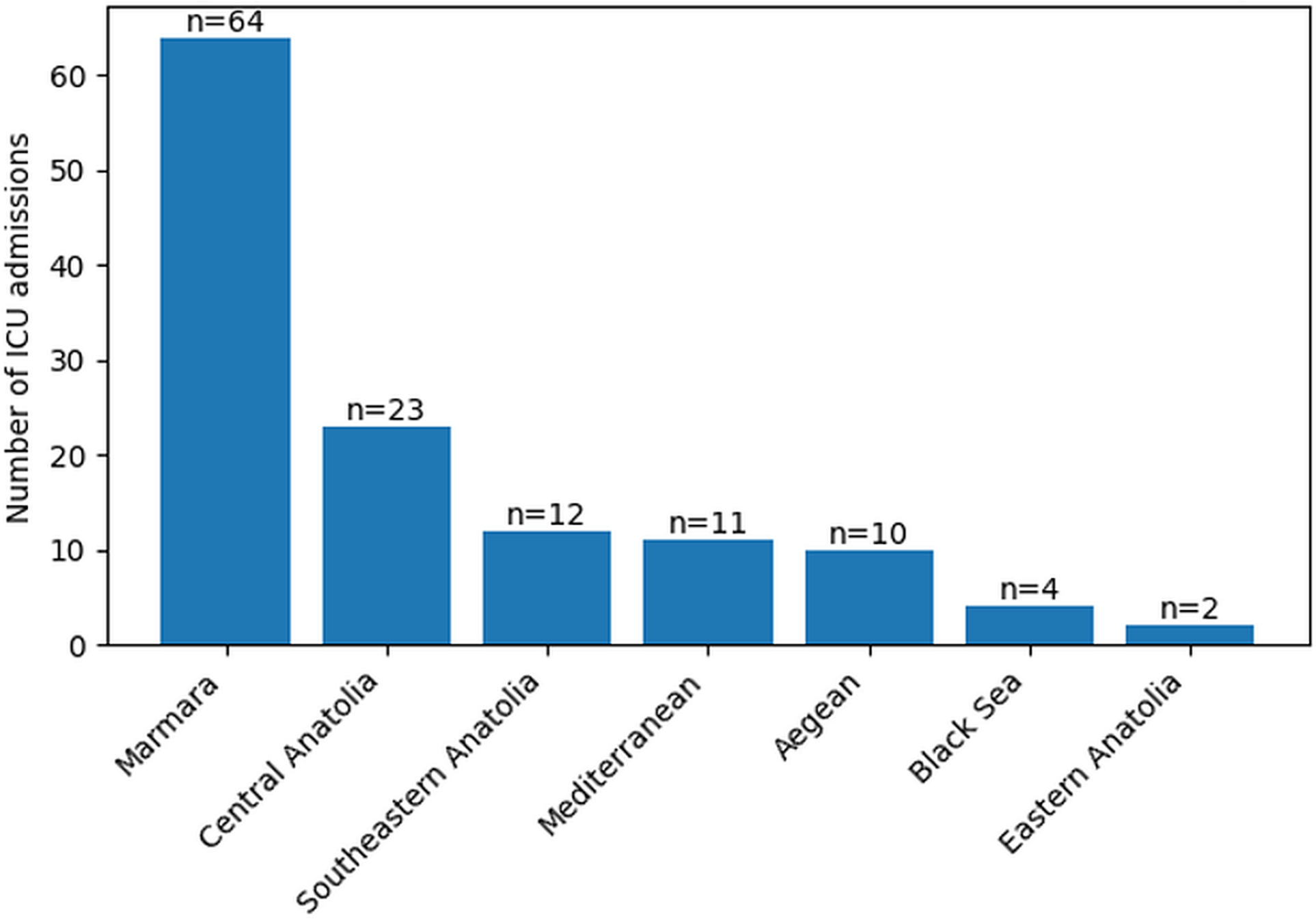
ICU admissions were unevenly distributed across the seven geographical regions of Türkiye (Figure 1). The majority of admissions occurred in the Marmara region (n=64, 50.8%), followed by the Central Anatolia region (n=23, 18.3%). Other regions contributed substantially fewer cases, including Southeastern Anatolia (n=12, 9.5%), Mediterranean (n=11, 8.7%), Aegean (n=10, 7.9%), Black Sea (n=4, 3.2%), and Eastern Anatolia (n=2, 1.6%).
Patient characteristics
The median age of the cohort was 30 years [23–41] and 60 patients (47.6%) were male. Overall ICU mortality was 32.5% (41 of 126 patients). When comparing survivors and non-survivors, non-survivors were older (median 32 [27–40] vs. 29 [21–46] years, p<0.01). Male sex was more frequent among survivors than non-survivors (54.1% vs. 34.1%, p=0.03). The most common primary admission diagnosis was respiratory failure (35.7%), followed by sepsis (20.6%). The distribution of respiratory failure did not differ significantly between survivors and non-survivors (p=0.88). In contrast, sepsis was more frequent among non-survivors (31.7% vs. 15.3%, p=0.03). Hypertension (36.5%), diabetes mellitus (31.8%), and coronary artery disease (23.8%) were the most common comorbidities. Hypertension, coronary artery disease, cerebrovascular disease, and heart failure were significantly more frequent among non-survivors (all p<0.05) (Table 3).
|
* median [IQR], AKI:acute kidney injury, CVD:cerebrovascular disease, GIH:gastrointestinal hemorrhage, CAD:coronary artery disease, CKD:chronic kidney disease, APACHE:acute physiology and chronic health evaluation, ICU:intensive care unit. |
||||
| Table 3. Characteristics of critically Ill patients with cystic fibrosis. | ||||
|
|
|
|
|
|
| Male gender, n (%) |
|
|
|
|
| Age * |
|
|
|
|
| Admission Diagnosis, n (%) | ||||
| Respiratory failure |
|
|
|
|
| Sepsis |
|
|
|
|
| Pulmonary embolism |
|
|
|
|
| AKI |
|
|
|
|
| Liver failure |
|
|
|
|
| CVD |
|
|
|
|
| GIH |
|
|
|
|
| Comorbidities, n (%) | ||||
| Hypertension |
|
|
|
|
| Diabetes mellitus |
|
|
|
|
| CAD |
|
|
|
|
| CVD |
|
|
|
|
| Heart failure |
|
|
|
|
| CKD |
|
|
|
|
| APACHE II score* |
|
|
|
|
| Non-invasive mechanical ventilation requirement , n (%) |
|
|
|
|
| Continous renal replacement therapy requirement, n (%) |
|
|
|
|
| Tracheotomy requirement, n (%) |
|
|
|
|
| Duration of ICU stay, days* |
|
|
|
|
The median APACHE II score at ICU admission was 12 [4–22]. Non-survivors had significantly higher APACHE II scores compared with survivors (21 [12–28] vs. 7 [3–13] , p<0.01). NIMV was required in 58.7% of patients and did not differ significantly between groups (p=0.23). CRRT and tracheotomy rates were low and were not significantly associated with ICU mortality. The median ICU length of stay was 2 days [1–7] in the overall cohort. Although the median duration was similar between survivors and non-survivors, the overall distribution of ICU length of stay differed significantly between the groups (p<0.01), reflecting differences in the distribution of values beyond the median alone (Table 3).
Discussion
In this nationwide retrospective cohort study, we describe the characteristics and outcomes of adult patients with CF admitted to ICUs across Türkiye over a six-year period. Several important findings emerged. First, ICU admissions were predominantly concentrated in Level 3 and mixed ICUs. Second, admissions demonstrated marked geographic clustering, with more than half occurring in the Marmara region. Third, overall ICU mortality was 32.5%. Mortality was significantly associated with older age, sepsis, cardiovascular comorbidities, and higher APACHE II scores at ICU admission. These findings provide the first national overview of ICU utilization and short-term outcomes among patients with CF in Türkiye. The predominance of Level 3 ICU admissions should be interpreted with caution. This distribution may reflect differences in local ICU infrastructure and referral pathways rather than illness severity alone. In addition, because cystic fibrosis is a relatively uncommon and specialized condition, clinicians may preferentially admit these patients to tertiary-level units for closer monitoring and access to advanced respiratory and multidisciplinary support, even when the initial degree of physiological instability is not severe.
ICU outcomes in patients with CF have evolved considerably over the past three decades. Early reports from the 1990s suggested that ICU admission—particularly when invasive mechanical ventilation was required—was associated with extremely poor prognosis, leading some to question the appropriateness of aggressive life-support measures in advanced CF. In one of the earliest cohort studies from the United States, ICU survival among intubated CF patients was limited and strongly influenced by transplant eligibility [13]. These findings contributed to a historically pessimistic view of ICU care in CF. In contrast, the overall ICU mortality in our contemporary nationwide cohort was 32.5%, suggesting that short-term outcomes are substantially more favorable than those described in historical series.
However, more contemporary studies have demonstrated substantial improvements in ICU survival, reflecting advances in ventilatory strategies, antimicrobial therapy, multidisciplinary CF care, and access to lung transplantation [14,15]. In a French multicenter study evaluating adults with CF admitted to ICUs, overall mortality was lower than previously reported, although invasive mechanical ventilation remained a strong determinant of death [16]. Similarly, subsequent studies from the United Kingdom and North America confirmed that ICU outcomes depend largely on the precipitating cause of respiratory failure, with better survival observed in patients intubated for potentially reversible conditions such as pneumothorax or hemoptysis compared with severe infective exacerbations [17,18]. Our findings are broadly consistent with this contemporary literature: respiratory failure was the most common reason for ICU admission (35.7%), while sepsis accounted for 20.6% of admissions and was more frequent among non-survivors (31.7% vs. 15.3%). Taken together, these findings place our national cohort within the evolving contemporary experience of critical care in adults with CF, in which ICU mortality remains substantial but is no longer uniformly poor.
Large administrative analyses from the United States further demonstrated that outcomes for adults with CF requiring invasive mechanical ventilation have improved over time, although mortality remains substantial, particularly among older patients and those with multiple comorbidities [10]. More recent data suggest that even advanced support modalities, including extracorporeal membrane oxygenation (ECMO), may be successfully applied in selected patients, particularly as a bridge to transplantation [19]. Against this evolving background, the ICU mortality rate of 32.5% observed in our nationwide cohort is consistent with contemporary registry-based reports describing short-term mortality between 25% and 40% among adults with cystic fibrosis admitted for acute respiratory failure or severe systemic complications [20,21]. In our cohort, APACHE II scores were substantially higher among non-survivors than survivors, indicating an association between greater physiological derangement at ICU admission and mortality. However, this finding should not be interpreted as demonstrating that acute illness severity is independent of the underlying severity of cystic fibrosis, since patients with more advanced disease may experience more pronounced physiological deterioration during acute exacerbations. Moreover, given the relatively young age of our cohort, the age component of APACHE II was unlikely to contribute substantially to the observed score differences. Several important cystic fibrosis–specific variables were unavailable in the national database, including baseline pulmonary function, CFTR modulator use, chronic microbiological colonization, nutritional status, and lung transplantation eligibility. These factors reflect important dimensions of underlying disease severity and may influence both the likelihood of ICU admission and subsequent outcomes. Their absence limits our ability to distinguish the contribution of acute critical illness from that of chronic CF disease burden and may also contribute to residual confounding in the observed associations with ICU mortality.
Sepsis was more frequent among non-survivors in our cohort, suggesting that infectious complications may be associated with adverse short-term outcomes in critically ill adults with CF. This finding is consistent with previous reports identifying severe pulmonary and systemic infections as important contributors to clinical deterioration in CF [22,23]. However, given the observational design and the absence of adjustment for potential confounders in the primary analysis, these findings should be interpreted as associations rather than evidence of a causal or independent effect.
Our cohort was older than the population described in the Turkish National Cystic Fibrosis Registry [24]. This difference should be interpreted in the context of the populations studied. Our cohort included only adults with cystic fibrosis requiring ICU admission and therefore represents a selected subgroup rather than the broader CF population included in the national registry. Patients requiring critical care may be older and have a greater cumulative disease burden than patients represented in disease-specific registries. Differences in population coverage between the national ICU database and the Turkish CF registry may also have contributed to the observed age discrepancy.
The prevalence of hypertension and coronary artery disease in our cohort was substantially higher than that reported in cystic fibrosis registries and other contemporary CF populations. In a large multinational analysis including 5,649 adults from the UK CF Registry and 6,265 adults from the TriNetX database, hypertension was present in only 2.2% and 11.8% of patients, respectively [25]. Similarly, the 2024 UK Cystic Fibrosis Registry reported hypertension in 3.3% of adults with CF [26]. Although the higher prevalence observed in our study may partly reflect the selected nature of an older, critically ill adult cohort, differences in cohort composition alone may not fully account for the magnitude of these findings. Because comorbidities were identified using routinely recorded ICD-10 codes in an administrative database, variation in coding practices and diagnostic misclassification may also have contributed to the observed prevalence estimates. Accordingly, these comorbidity data should be interpreted with caution and should not be considered directly comparable with prevalence estimates derived from dedicated cystic fibrosis registries.
Cardiovascular comorbidities were more frequent among non-survivors in our cohort; however, their overall prevalence was considerably higher than that reported in contemporary cystic fibrosis populations. Cardiovascular disease has historically been considered uncommon in CF, although its clinical relevance may increase as the CF population ages and develops conventional cardiovascular risk factors [27]. Ticona et al. similarly emphasized that cardiovascular disease remains relatively uncommon in people with CF but may become increasingly important with advancing age [28]. Therefore, the high prevalence of hypertension and coronary artery disease observed in our relatively young ICU cohort should not be attributed solely to the aging of the CF population. As these comorbidities were identified using routinely recorded ICD-10 codes in an administrative database, differences in coding practices and diagnostic misclassification may have contributed to the observed estimates. These findings should therefore be interpreted cautiously.
The distribution of ICU admissions across levels should be interpreted within the context of the Turkish critical care system. The absence of Level 1 admissions and the predominance of Level 3 care may not reflect patient acuity alone. Differences in the availability of ICU levels across hospitals, regional referral pathways, and the tendency to manage patients with a rare and complex disease such as cystic fibrosis in tertiary centers may all have influenced the observed distribution. In particular, patients may have been admitted directly to higher-level units for closer monitoring and access to advanced respiratory and multidisciplinary support. Because information on the availability of individual ICU levels at each hospital was not available in the national database, the relative contribution of infrastructure, referral practice, and clinical severity cannot be determined from our data.
The marked geographic concentration of ICU admissions in the Marmara region may reflect regional differences in population density, availability of specialized CF services, and tertiary referral patterns rather than true geographic variation in the burden of critical illness. Because center-level referral pathways and CF expertise were not available in the database, this finding should be interpreted cautiously.
The median ICU length of stay was 2 days. However, the administrative dataset did not provide sufficiently granular information on discharge destination, inter-ICU transfer, or treatment trajectory to determine the reasons for this relatively short duration. Therefore, ICU length of stay should be interpreted descriptively rather than as a direct indicator of disease severity or efficiency of care.
Finally, it is noteworthy that, in contrast to some historical studies emphasizing invasive mechanical ventilation as a near-uniformly fatal event in advanced CF [13], contemporary evidence—including our national data—supports a more nuanced perspective. Although detailed information regarding invasive mechanical ventilation, including its frequency, duration, and associated outcomes, was also not available in our database, ICU admission in CF should not be viewed as uniformly futile; rather, prognosis appears to depend on age, baseline comorbidity burden, acute severity, and the reversibility of the precipitating event [29,30]. This shift in understanding mirrors the broader transformation of CF from a predominantly pediatric fatal disease to a chronic adult condition with increasingly complex systemic manifestations.
The principal strength of this study lies in its nationwide design, encompassing all ICU levels and hospital types across Türkiye over a six-year period. By capturing data from a centralized national database, this study provides a comprehensive overview of ICU admissions among adults with cystic fibrosis in a real-world healthcare setting. To our knowledge, this is the first study to characterize ICU utilization and short-term outcomes of patients with CF at a national level in Türkiye. The national database includes administrative and clinical records from public, university, and private hospitals throughout Türkiye, providing broad coverage of ICU care across different hospital types and levels. This nationwide scope reduces the potential for single-center or regional selection bias and supports the representativeness of our findings for adults with CF receiving intensive care in Türkiye. However, because case identification relied on routinely recorded ICD-10 codes rather than a dedicated CF registry, some degree of under-ascertainment remains possible. Accordingly, these findings should be considered representative of the ICU-treated adult CF population captured within the national healthcare database rather than of the entire adult CF population in Türkiye.
Nevertheless, several limitations should be considered. First, the retrospective design and reliance on ICD-10–based administrative coding for case identification introduce the possibility of misclassification or under-ascertainment. Although standardized coding enhances nationwide comparability, variations in documentation practices may have resulted in incomplete identification of eligible patients. Second, granular clinical information—such as baseline pulmonary function, microbiological profiles, transplant eligibility, CFTR modulator use, and genetic subtype—was not available in the registry dataset. Third, outcomes were limited to the ICU period, and long-term survival, rehospitalization, and post-discharge functional status could not be evaluated. Information on the availability of Level 1, Level 2, and Level 3 ICUs at individual hospitals was not available. Therefore, the observed distribution of admissions across ICU levels may partly reflect local ICU infrastructure and referral patterns rather than patient acuity alone. Finally, given the limited number of outcome events and the sparse distribution of several candidate covariates, together with uncertainty regarding the validity of some ICD-10–derived comorbidity variables, multivariable modelling was not performed because of concern for overfitting and unstable adjusted estimates. Accordingly, the observed associations should be interpreted as exploratory and unadjusted.
Despite these limitations, this study provides an important contemporary national perspective on ICU care in adults with cystic fibrosis. The findings suggest that short-term ICU mortality is primarily associated with acute disease severity and infectious complications, while the observed regional clustering likely reflects healthcare system organization and referral pathways rather than true epidemiologic variation. These data contribute to the limited global literature on critical care utilization in CF and underscore the need for prospective, multicenter investigations incorporating detailed clinical variables and longitudinal follow-up to better inform risk stratification and policy planning.
Conclusion
In conclusion, this nationwide study provides the first comprehensive overview of ICU admissions among adults with CF in Türkiye. ICU mortality in this cohort was comparable to contemporary reports from high-income countries and was primarily associated with acute disease severity, infectious complications, and comorbidity burden. The marked regional clustering of admissions likely reflects healthcare system organization and tertiary referral patterns rather than true epidemiologic variation. These findings underscore that ICU care in CF should not be viewed as uniformly futile but rather as a context-dependent clinical decision shaped by patient age, acute physiologic status, and reversibility of the precipitating event. Future prospective, multicenter studies incorporating detailed clinical data and long-term outcomes are warranted to refine risk stratification and optimize critical care strategies for this evolving adult CF population.
Ethical approval
This study was approved by the Republic of Türkiye Ministry of Health (Date: 27.11.2019, protocol no:95741342-020). The analysis was based on anonymized, routinely collected national registry data, and individual patient consent was not required.
Data availability statement
The data that support the findings of this study are available from the corresponding author upon reasonable request.
Conflict of interest
The authors declare that this study was conducted in the absence of any commercial or financial relationships that could be construed as a potential conflict of interest.
Funding
The authors declare that this study received no funding.
Generative AI statement
The authors declare that during the preparation of this study, the following AI-assisted technology was used: ChatGPT, OpenAI on manuscript preparation and revision period (01.05.26/12.09.26). Extent of Use: ChatGPT was used solely for language editing and to improve the clarity and readability of the manuscript. All AI-assisted text was critically reviewed and revised by the authors, who take full responsibility for the final content. The authors confirm that they have critically reviewed and edited any AI-generated content and take full responsibility for the integrity, accuracy, and originality of the publication. The authors certify that the original human contribution is maintained and that AI-assisted tools are not listed or cited as authors.
References
- Elborn JS. Cystic fibrosis. Lancet 2016;388(10059):2519-31. https://doi.org/10.1016/S0140-6736(16)00576-6
- Stephenson AL, Sykes J, Stanojevic S, et al. Survival comparison of patients with cystic fibrosis in canada and the united states: a population-based cohort study. Ann Intern Med 2017;166(8):537-46. https://doi.org/10.7326/M16-0858
- Keogh RH, Seaman SR, Barrett JK, Taylor-Robinson D, Szczesniak R. Dynamic prediction of survival in cystic fibrosis: a landmarking analysis using uk patient registry data. Epidemiology 2019;30(1):29-37. https://doi.org/10.1097/EDE.0000000000000920
- Cystic Fibrosis Foundation. Dispelling misconceptions about cystic fibrosis. Available at: https://www.cff.org/intro-cf/dispelling-misconceptions-about-cystic-fibrosis (Accessed on Aug 18, 2026).
- Ademhan Tural D, Şişmanlar Eyüboğlu T, Cinel G, et al. Current status of cystic fibrosis in Türkiye: data from the national registry. Thorac Res Pract 2025;26(5):238-47. https://doi.org/10.4274/ThoracResPract.2025.2025-1-11
- Nick JA, Chacon CS, Brayshaw SJ, et al. Effects of gender and age at diagnosis on disease progression in long-term survivors of cystic fibrosis. Am J Respir Crit Care Med 2010;182(5):614-26. https://doi.org/10.1164/rccm.201001-0092OC
- Hayes D, Kopp BT, Preston TJ, et al. Survival of patients with cystic fibrosis on ECMO: analysis of the extracorporeal life support organization registry. Int J Clin Exp Med 2014;7(5):1370-2.
- Flume PA, O’Sullivan BP, Robinson KA, et al. Cystic fibrosis pulmonary guidelines: chronic medications for maintenance of lung health. Am J Respir Crit Care Med 2007;176(10):957-69. https://doi.org/10.1164/rccm.200705-664OC
- Bell SC, Mall MA, Gutierrez H, et al. The future of cystic fibrosis care: a global perspective. Lancet Respir Med 2020;8(1):65-124. https://doi.org/10.1016/S2213-2600(19)30337-6
- Siuba M, Attaway A, Zein J, et al. Mortality in adults with cystic fibrosis requiring mechanical ventilation. Cross-sectional analysis of nationwide events. Ann Am Thorac Soc 2019;16(8):1017-23. https://doi.org/10.1513/AnnalsATS.201804-268OC
- Saydain G, Islam A, Afessa B, Ryu JH, Scott JP, Peters SG. Outcome of patients with idiopathic pulmonary fibrosis admitted to the intensive care unit. Am J Respir Crit Care Med 2002;166(6):839-42. https://doi.org/10.1164/rccm.2104038
- Kerem E, Reisman J, Corey M, Canny GJ, Levison H. Prediction of mortality in patients with cystic fibrosis. N Engl J Med 1992;326(18):1187-91. https://doi.org/10.1056/NEJM199204303261804
- Sood N, Paradowski LJ, Yankaskas JR. Outcomes of intensive care unit care in adults with cystic fibrosis. Am J Respir Crit Care Med 2001;163(2):335-8. https://doi.org/10.1164/ajrccm.163.2.2003076
- MacKenzie T, Gifford AH, Sabadosa KA, et al. Longevity of patients with cystic fibrosis in 2000 to 2010 and beyond: survival analysis of the Cystic Fibrosis Foundation patient registry. Ann Intern Med 2014;161(4):233-41. https://doi.org/10.7326/M13-0636
- Smith MA, McGarry ME, Ly NP, Zinter MS. Outcomes of children with cystic fibrosis admitted to PICUs. Pediatr Crit Care Med 2020;21(10):e879-87. https://doi.org/10.1097/PCC.0000000000002358
- Texereau J, Jamal D, Choukroun G, et al. Determinants of mortality for adults with cystic fibrosis admitted in Intensive Care Unit: a multicenter study. Respir Res 2006;7(1):14. https://doi.org/10.1186/1465-9921-7-14
- Jones A, Bilton D, Evans TW, Finney SJ. Predictors of outcome in patients with cystic fibrosis requiring endotracheal intubation. Respirology 2013;18(4):630-6. https://doi.org/10.1111/resp.12051
- Hayes D, McCoy KS, Whitson BA, Mansour HM, Tobias JD. High-risk age window for mortality in children with cystic fibrosis after lung transplantation. Pediatr Transplant 2015;19(2):206-10. https://doi.org/10.1111/petr.12401
- Gibilaro JM, Keating C, Benvenuto L, et al. Survival in cystic fibrosis after acute respiratory failure supported by extracorporeal membrane oxygenation and/or invasive mechanical ventilation. J Cyst Fibros 2022;21(4):669-74. https://doi.org/10.1016/j.jcf.2021.08.016
- Sanders DB, Bittner RCL, Rosenfeld M, Hoffman LR, Redding GJ, Goss CH. Failure to recover to baseline pulmonary function after cystic fibrosis pulmonary exacerbation. Am J Respir Crit Care Med 2010;182(5):627-32. https://doi.org/10.1164/rccm.200909-1421OC
- Cystic Fibrosis Foundation. Patient registry. Available at: https://www.cff.org/medical-professionals/patient-registry (Accessed on Feb 11, 2026).
- Chun SW, Somers ME, Burgener EB. Highly effective cystic fibrosis transmembrane conductance (regulator) modulator therapy: shifting the curve for most while leaving some further behind. Curr Opin Pediatr 2024;36(3):290-5. https://doi.org/10.1097/MOP.0000000000001338
- Britto CJ, Taylor-Cousar JL. Cystic fibrosis in the era of highly effective CFTR modulators. Clin Chest Med 2022;43(4):xiii-xvi. https://doi.org/10.1016/j.ccm.2022.07.003
- Çocuk Solunum Yolu Hastalıkları ve Kistik Fibrozis Derneği. Ulusal kistik fibrozis kayıt sistemi 2024 yılı verileri. Available at: https://www.kistikfibrozisturkiye.org/wp-content/uploads/2025/12/UKKS-29Aralik2025-03.pdf (Accessed on Aug 18, 2026).
- Frost F, Nazareth D, Fauchier L, et al. Prevalence, risk factors and outcomes of cardiac disease in cystic fibrosis: a multinational retrospective cohort study. Eur Respir J 2023;62(4):2300174. https://doi.org/10.1183/13993003.00174-2023
- Cystic Fibrosis Trust. Registry annual report. Available at: https://www.cysticfibrosis.org.uk/about-us/uk-cf-registry/reporting-and-resources (Accessed on Aug 18, 2026).
- Shah PH, Lee JH, Salvi DJ, Rabbani R, Gavini DR, Hamid P. Cardiovascular system ınvolvement in cystic fibrosis. Cureus 2021;13(7):e16723. https://doi.org/10.7759/cureus.16723
- Ticona JH, Lapinel N, Wang J. Future comorbidities in an aging cystic fibrosis population. Life (Basel) 2023;13(6):1305. https://doi.org/10.3390/life13061305
- Marques LS, Boschiero MN, Sansone NMS, Brienze LR, Marson FAL. Epidemiological profile of hospitalized patients with cystic fibrosis in Brazil due to severe acute respiratory infection during the COVID-19 pandemic and a systematic review of worldwide COVID-19 in those with cystic fibrosis. Healthcare (Basel) 2023;11(13):1936. https://doi.org/10.3390/healthcare11131936
- King CS, Brown AW, Aryal S, Ahmad K, Donaldson S. Critical care of the adult patient with cystic fibrosis. Chest 2019;155(1):202-14. https://doi.org/10.1016/j.chest.2018.07.025
Copyright and License
Copyright © 2026 The Author(s). This is an open access article distributed under the Creative Commons Attribution License (CC BY), which permits unrestricted use, distribution, and reproduction in any medium or format, provided the original work is properly cited.