


Abstract
Objective: The increasing incidence of early-onset colorectal cancer (EO-CRC) has raised the question of whether these tumors exhibit different molecular characteristics from late-onset colorectal cancer (LO-CRC). We aimed to compare the somatic genomic profiles of EO-CRC and LO-CRC.
Materials and Methods: Clinical and genomic data of patients diagnosed with colon adenocarcinoma, colorectal adenocarcinoma, and rectal adenocarcinoma from the AACR Project GENIE Cohort v20.0 database were retrospectively evaluated. Patients were divided into two groups based on age at diagnosis: early-onset (<50 years) and late-onset (≥50 years). The groups were compared in terms of demographic characteristics, number of mutations, altered genome fraction, and gene mutation frequencies. Multiple-testing correction was performed using the Benjamini–Hochberg method in the main analysis, genes with a mutation frequency ≥5% in at least one group were focused on.
Results: A total of 23,410 samples from 22,142 patients were evaluated. TP53 (74.62% vs. 69.53%), APC (70.20% vs. 65.82%), and TCF7L2 (14.61% vs. 12.27%) mutations were more frequent in the EO-CRC group, while BRAF (7.16% vs. 13.55%) and RNF43 (6.98% vs. 10.80%) mutations were more frequent in the LO-CRC group (all q<0.01). Additionally, AXIN2, PLCG2, AMER1, MSH3, MGA, SOX9, and SPEN mutations were found to be significantly more frequent in the LO-CRC group.
Conclusion: There are significant differences in somatic genomic profiles between early-onset and late-onset colorectal cancers. The more frequent occurrence of TP53, APC, and TCF7L2 mutations in EO-CRC, and BRAF and RNF43 mutations in LO-CRC, suggests that the relative contribution of molecular pathways involved in colorectal carcinogenesis may differ according to age. However, these findings do not support the evaluation of EO-CRC as a completely separate molecular disease based solely on age.
Keywords: colorectal cancer, genomic variation, early onset
Introduction
Colorectal cancer (CRC) is the third most common cancer worldwide. In terms of mortality rates, it is the second leading cause of cancer-related deaths [1]. Related to the widespread use of screening programs, the incidence and mortality of colorectal cancer detected in individuals aged 50 and over have shown a declining trend over time [2]. However, the incidence of early-onset colorectal cancer (EO-CRC), defined as colorectal cancer diagnosed before the age of 50 years, has been increasing in recent decades [1-5].
The majority of EO-CRC cases originate from the rectum and distal colon. Cases typically present with an aggressive pathology, often as poorly differentiated carcinoma or signet ring cell carcinoma. Patients with EO-CRC are usually diagnosed at an advanced stage. All these characteristics present challenges in clinical management [3,5-8].
Hereditary predisposition plays a significant role in the development of EO-CRC. Germline pathogenic variations in cancer susceptibility genes, such as Lynch syndrome (MLH1, MSH2, MSH6, PMS2 mutations), Familial Adenomatous Polyposis (FAP) [adenomatous polyposis coli (APC) mutations], or MUTYH mutations, are detected in approximately 20% to 25% of young colorectal cancer patients compared to older patients [3,4,9,10]. However, the vast majority (75-80%) of EO-CRC cases consist of sporadic tumors that do not carry a hereditary predisposition [3,6].
This epidemiological and clinical divergence has raised the question of whether EO-CRC is a distinct entity at the biological and molecular level from late-onset colorectal cancer (LO-CRC). Furthermore, understanding the molecular mechanisms behind sporadic cases is critical for optimizing both early diagnostic detection and personalized treatment approaches.
The aim of this study is to investigate the differences in genetic variation between early-onset and late-onset colorectal cancers.
Materials and Methods
AACR project GENIE
The American Association for Cancer Research (AACR) Project Genomics, Evidence, Neoplasia, Information, and Exchange (GENIE) is an international collaborative initiative established to facilitate the sharing of genomic and clinical data and support precision oncology research [11-13]. Data analyzed in the present study were obtained from the publicly available AACR Project GENIE cohort v20.0 through cBioPortal for Cancer Genomics.
AACR Project GENIE integrates routinely generated clinical and genomic data from participating institutions worldwide. Genomic testing data contributed to the registry are generated in Clinical Laboratory Improvement Amendments (CLIA)-certified and/or International Organization for Standardization (ISO)-accredited laboratory environments [13]. Data sharing within the consortium is governed by institutional agreements and the Institutional Review Board (IRB) requirements of participating centers. Depending on institutional policies, authorization for data contribution may be based on prospective patient consent, an IRB-approved waiver, or approval of GENIE-specific research protocols [13]. Data made available for research are de-identified to protect patient confidentiality.
Statistical analyses
This study included patients diagnosed with colon adenocarcinoma, colorectal adenocarcinoma, and rectal adenocarcinoma from the AACR Project GENIE Cohort v20.0 database [13-15]. Demographic characteristics, clinicopathological findings, and genomic data of the patients were analyzed retrospectively. Patients were categorized into two groups according to age at diagnosis: early-onset colorectal cancer (EO-CRC), defined as <50 years, and late-onset colorectal cancer (LO-CRC), defined as ≥50 years. The groups were compared in terms of demographic characteristics and genetic mutations. The Chi-square test was used for categorical variables, the Kruskal-Wallis test for continuous variables, and the Wilcoxon test for comparing paired groups with abnormal distributions. The Benjamini-Hochberg method was applied to correct P-values, and consequently, false discovery rate-adjusted q-values were computed. Results were considered statistically significant when both the q-value and P-value were below 0.05. For clarity and to focus on more prevalent molecular events, genes with a mutation frequency of ≥5% in at least one group were highlighted in the main analysis.
Results
A total of 23,410 samples from 22,142 patients were evaluated. Data centers are shown in Table 1. A total of 16,667 samples from 15,858 patients belonged to patients aged 50 and over (LO-CRC). A total of 6,701 samples from 6,289 patients belonged to patients under 50 years of age (EO-CRC).
| *Data are represented as numbers (N) and percentages (%). | |
| Table 1. Data center. | |
| Data center |
|
| Memorial Sloan Kettering Cancer Center |
|
| Dana-Farber Cancer Institute |
|
| Providence Health and Services Cancer Institute |
|
| The Herbert Irving Comprehensive Cancer Center, Columbia University |
|
| Johns Hopkins Sidney Kimmel Comprehensive Cancer Center |
|
| The University of Texas MD Anderson Cancer Center |
|
| Vall d’Hebron Institute of Oncology |
|
| Duke Cancer Institute, Duke University Health System |
|
| Netherlands Cancer Center, The Netherlands |
|
| Princess Margaret Cancer Centre, University Health Network |
|
| Vanderbilt-Ingram Cancer Center |
|
| University of California-San Francisco (UCSF Helen Diller Family Comprehensive Cancer Center) |
|
| Wake Forest University Health Sciences, Wake Forest Baptist Medical Center |
|
| Yale University, Yale Cancer Center |
|
| The University of Chicago |
|
| Institut Gustave Roussy |
|
| Swedish Cancer Institute. |
|
| University of Miami - Sylvester Comprehensive Cancer Center |
|
In LO-CRC group, 9,630 (57.8%) samples were taken from the primary site, while 4,877 (29.3%) samples were taken from the metastatic site. Ninety-six (0.6%) patients had cell-free DNA samples. Information on 2,064 (12.4%) samples could not be obtained. Of the patients with LO-CRC, 9,585 (60.4%) were Caucasian.
In EO-CRC patients, 4244 (63.3%) samples were from the primary site, 1948 (29.1%) from the metastatic site. Twenty-two (0.3%) samples were from cell-free DNA. A total of 487 (7.3%) samples were of unknown origin. Of the patients with EO-CRC, 3898 (62%) were Caucasian.
A statistically significant difference was found in gender distribution between early-onset and late-onset colorectal adenocarcinoma groups (p < 0.001; q < 0.001). Male patients constituted the highest proportion in both groups, although the proportion of men was relatively higher in the late-onset group (Figure 1).
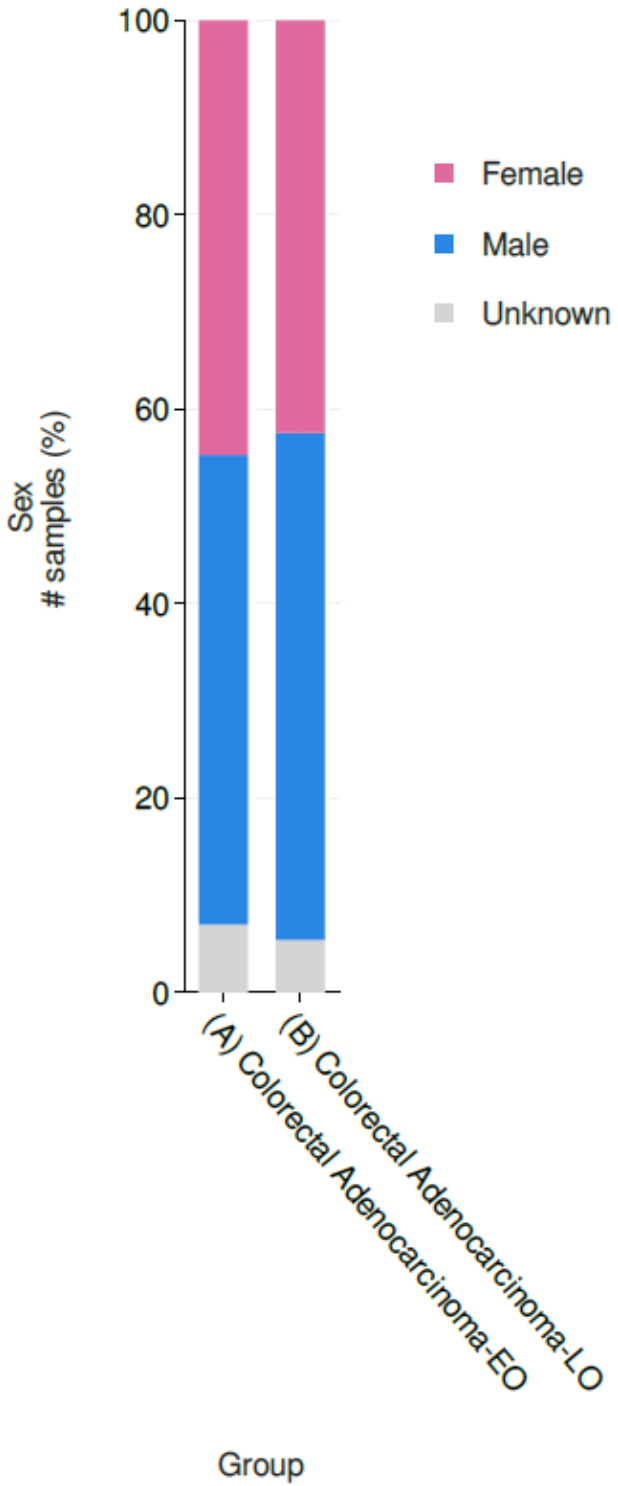
A significant difference in sex distribution was observed between the two groups p<0.01,q<0.01
Data are represented as numbers (N) and percentages (%).
There was a statistically significant difference in mutational count distribution between the early-onset and late-onset colorectal cancer groups. The median mutational count was 8 (q1-q3:4-12) in late-onset patients, and the mutational count was 7 (q1-q3:4-11) in early-onset patients (q-value <0.001, p-value <0.001).
There was a statistically significant difference in the distribution of fractionally altered genome between the early-onset and late-onset colorectal cancer groups. The median fractional genome altered distribution was 0.17 (q1-q3: 0.05-0.31) in late-onset patients and 0.16 (q1-q3: 0.05-0.31) in early-onset patients (q-value <0.005, p-value <0.005).
Mutation frequency analysis revealed significant differences between early-onset (EO) and late-onset (LO) colorectal adenocarcinomas (Figure 2). Among statistically significant genes (q < 0.05), only those with a mutation frequency of ≥5% in at least one group were included in the main analysis. BRAF (13.55% vs. 7.16%; q <0.01) and RNF43 (10.80% vs. 6.98%; q < 0.01) mutations were significantly more frequent in the LO group. In contrast, TP53 (74.62% vs. 69.53%; q <0.01) and APC (70.20% vs. 65.82%; q <0.01) mutations were significantly more frequent in the EO group. TCF7L2 mutations were also enriched in the EO group (14.61% vs. 12.27%; q < 0.01), whereas AXIN2, PLCG2, AMER1, MSH3, MGA, SOX9, and SPEN mutations were significantly enriched in the LO group (all q < 0.05) (Table 2).
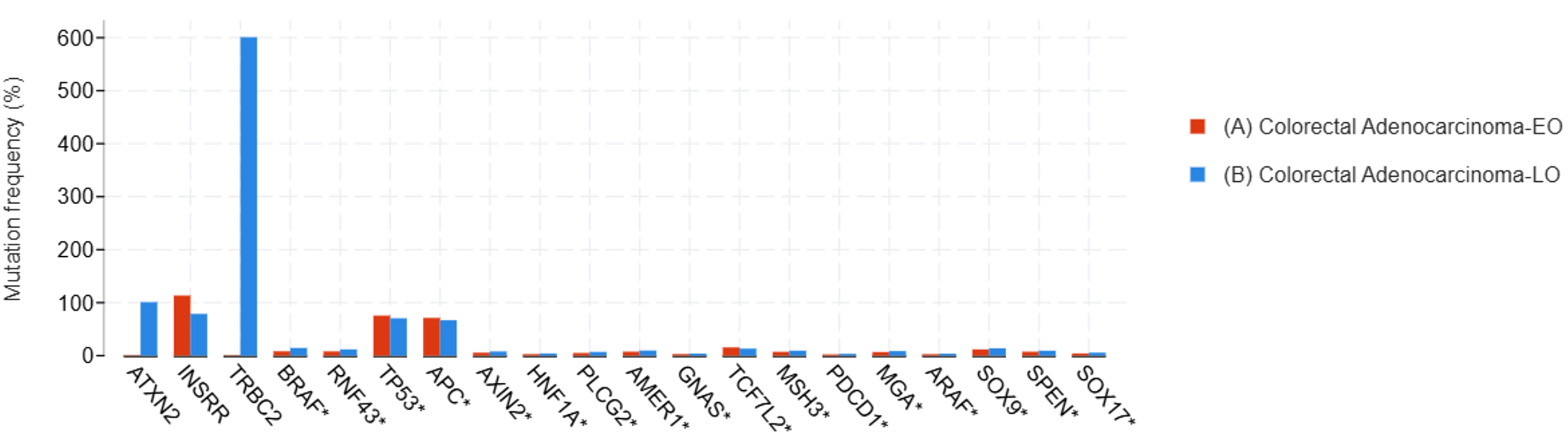
Data are represented as percentages (%).
*The difference between the groups was statistically significant (q < 0.05).
| EO-CRC: Early onset colorectal carcinoma, LO-CRC: Late-onset colorectal carcinoma. | ||||
| Table 2. Differentially mutated genes in early-onset and late-onset colorectal cancer. | ||||
| Gene |
|
|
|
|
| AXIN2 |
|
|
|
|
| PLCG2 |
|
|
|
|
| AMER1 |
|
|
|
|
| MSH3 |
|
|
|
|
| MGA |
|
|
|
|
| SOX9 |
|
|
|
|
| SPEN |
|
|
|
|
Discussion
In this study, we retrospectively demonstrated differences in genomic mutations between patients with early-onset and late-onset colorectal cancer in a large cohort. In our study, APC and TP53 mutations were more frequently observed in early-onset colorectal carcinoma, while BRAF and RNF43 mutations were more common in late-onset colorectal carcinoma. Less frequently, mutations such as AXIN2, PLCG2, AMER1, MSH3, MGA, SOX9, and SPEN were more common in late-onset colorectal carcinoma.
The increasing incidence of early-onset colorectal carcinoma in recent years and the aggressive course of this disease have led to increased research on this patient group.
TP53 mutation have an important regulatory effect on colorectal tumor formation, particularly during the adenoma-carcinoma transition. TP53 mutation lead to various functional changes affecting invasion, metastasis, apoptosis, and drug resistance [16]. TP53 mutation is one of the most common mutations in patients with colorectal cancer [17,18]. Lieu et al. showed that TP53 alterations are more frequently observed in patients diagnosed with EO-CRC [19]. Li et al. showed that the TP53 mutation was found more frequently in patients with non-hypermutated colon cancer than in patients diagnosed with EO-CRC [6]. Lawler et al. reported in a meta-analysis of 149 articles that TP53 mutation is more frequently observed in EO-CRC [20]. In the study by Pretta et al., which evaluated 1209 colorectal cancer patients using Foundation One, it was also reported that TP53 mutation was more common in EO-CRC patients [21]. In our study, similar to the literature, TP53 mutation was found to be more prevalent in EO-CRC patients.
Inactivation of APC, a tumor suppressor gene, has been considered a significant early event in up to 85% of sporadic colorectal cancers [22,23]. APC is one of the key tumor suppressor genes in colorectal carcinogenesis and plays a critical role in the regulation of the WNT signaling pathway. The central role of APC in both sporadic CRC and inherited syndromes such as FAP is well understood [10,22-25]. However, previous studies examining the distribution of APC mutations between young and elderly patients have reported heterogeneous results. Some studies have reported lower rates of APC mutations in EO-CRC, particularly in specific molecular subgroups, while others have shown similar or higher frequencies in EO-CRC [6,7,17-19,21]. In our study we showed that APC mutations were significantly more frequent in the EO-CRC group. TCF7L2 is one of the most frequently mutated genes in colorectal cancer. It is a key transcriptional effector of the WNT signaling pathway [26]. In our study, we showed that TCF7L2 mutations were more frequent in the EO-CRC group. In the study by Li et al., TCF7L2 was also observed more frequently in early-onset colorectal cancer with a high tumor mutation burden (TMB > 15 mutations/Mb) [6]. The higher frequency of APC and TCF7L2 alterations in the same age group suggests potential age-related differences in the contribution of WNT pathway alterations to colorectal carcinogenesis. Various studies have shown that different alterations in the WNT signaling pathway can be concentrated in different EO-CRC subgroups, depending on molecular characteristics such as MSI status and mutation burden [6,18,21,27].
The most common BRAF mutation is BRAFV600E. Literature shows that BRAFV600E mutations are found in approximately 5-10% of patients with colorectal carcinoma [28]. In our study, BRAF mutation was found to be significantly more frequent in LO-CRC than EO-CRC, which is largely consistent with the literature. It is known that BRAF V600E mutations are more common in older patients with colorectal carcinoma [3,7,19,25]. Several studies comparing early-onset and late-onset CRC have also reported that BRAF mutations are less frequent in younger patients [6,7,17-19,29].
In our study, RNF43 mutations were also detected significantly more frequently in the LO-CRC group. RNF43 is one of the negative regulators of WNT signaling and can undergo recurrent mutations in colorectal tumors. Yan et al. showed a close association between RNF43 mutations and serrated neoplasia and BRAF mutations [30].
In this study we also found that mutations in AXIN2, PLCG2, AMER1, MSH3, MGA, SOX9, and SPEN were significantly more frequent in the LO-CRC group. While the clinical significance of age-related differences in these genes is not yet clear, some are associated with known molecular pathways in colorectal cancer pathogenesis [27,31]. AXIN2 and AMER1 are involved in the regulation of WNT/β-catenin signaling, while SOX9 plays a role in intestinal epithelial differentiation and stem cell biology. AMER1 was previously identified as one of the recurrently mutated genes in colorectal cancer through exome sequencing studies [32-34]. MSH3 is involved in the DNA mismatch repair mechanism, and changes in this gene may be associated with certain genomic instability phenotypes [35]. SPEN is a gene involved in transcriptional regulation, and recent data suggest that SPEN mutations may be a potential biomarker associated with immunotherapy response in colorectal cancer [36]. Large-scale studies are needed to more clearly define the effects of these genes in patients with colorectal cancer.
In our study, male patients constituted the majority in both the EO-CRC and LO-CRC groups; however, the proportion of males was significantly higher in the LO-CRC group. Previous studies have reported conflicting results regarding gender distribution in EO-CRC; some cohorts show a male predominance, while others indicate a higher proportion of women or a correlation between female gender and younger age at diagnosis. In the study by Park et al., 52.5% of cases in the 20-49 age range were male [8]. Siddique et al. reported that male gender was associated with an increased risk of early-onset colorectal cancer [37]. Abdel-Rahman et al. showed that colorectal cancer diagnosis at a younger age was associated with female gender [38].
In our study, the median mutational count was significantly lower in patients with EO-CRC than in those with LO-CRC. Similarly, the median fraction of genome altered was slightly lower in the EO-CRC group than in the LO-CRC group. Although these differences were statistically significant, their absolute magnitudes were modest, and their clinical relevance remains uncertain.
This study has some limitations. Primarily, due to its retrospective design, there are gaps in clinical features such as family history, tumor stage, lymph node involvement, metastasis status, patient survival time, and treatment modalities. Furthermore, genomic assessments such as tumor mutational burden, mRNA sequencing, and miRNA analysis are not available for these patients. Additionally, the inclusion of both primary and metastatic tumor samples may have introduced heterogeneity into the genomic comparisons, as the mutational profiles of metastatic tumors may differ from those of primary tumors due to tumor evolution and treatment-related selective pressures. Furthermore, molecular subgroups based on microsatellite instability (MSI) or microsatellite stability (MSS) could not be adequately controlled for in the present analysis. As MSI status is associated with distinct genomic profiles and may influence the frequency of several mutations, the lack of stratification according to MSI/MSS status may have affected the observed differences between the EO-CRC and LO-CRC groups.
In conclusion, our study demonstrates measurable differences in somatic genomic profiles between EO-CRC and LO-CRC. The higher frequency of TP53, APC, and TCF7L2 mutations in EO-CRC, and conversely, the enrichment of BRAF, RNF43, and various other gene alterations in LO-CRC, suggest that the relative contribution of molecular pathways involved in colorectal carcinogenesis may differ according to age. However, EO-CRC should not be considered a completely separate molecular disease based solely on age. These molecular differences are important in terms of their potential to guide future screening, prognosis, or personalized treatments.
Ethical approval
This study was conducted using de-identified clinical and genomic information available through the American Association for Cancer Research (AACR) Project GENIE registry. Protection of participant privacy and confidentiality is governed by the ethical and regulatory procedures of the GENIE consortium and the Institutional Review Boards (IRBs) of the contributing institutions. Depending on local institutional policies, submission of data to the registry is permitted through informed consent for sharing de-identified molecular information, an IRB-approved waiver of consent, or institutionally approved GENIE research protocols. All patient-level information is de-identified before being incorporated into the registry in accordance with the HIPAA Safe Harbor standards. Because the current analysis relied solely on previously collected and de-identified registry data, investigators had no direct interaction with participants and no additional specimens or biological materials were obtained.
Data availability statement
Data sharing is not applicable to this article as no new datasets were generated or analyzed during this study.
Conflict of interest
The authors declare that this study was conducted in the absence of any commercial or financial relationships that could be construed as a potential conflict of interest.
Funding
The authors declare that this study received no funding.
Generative AI statement
The authors declare that no generative AI or AI-assisted technologies were used in the writing or preparation of this study.
Acknowledgments
The authors gratefully acknowledge the American Association for Cancer Research (AACR) for the development and continued support of the AACR Project GENIE registry. We also thank all participating institutions and consortium members for contributing genomic and clinical data that enabled this research. The findings, interpretations, and conclusions reported herein are the responsibility of the authors and do not necessarily reflect those of AACR Project GENIE or its participating institutions.
References
- Sung H, Filho AM, Laversanne M, et al. Global cancer statistics 2024: GLOBOCAN estimates of incidence and mortality worldwide for 34 cancers in 186 countries. CA Cancer J Clin 2026;76(4):e70090. https://doi.org/10.3322/caac.70090
- Morgan E, Arnold M, Gini A, et al. Global burden of colorectal cancer in 2020 and 2040: incidence and mortality estimates from GLOBOCAN. Gut 2023;72(2):338-44. https://doi.org/10.1136/gutjnl-2022-327736
- Saraiva MR, Rosa I, Claro I. Early-onset colorectal cancer: a review of current knowledge. World J Gastroenterol 2023;29(8):1289-303. https://doi.org/10.3748/wjg.v29.i8.1289
- Turk A, Mondaca S, Nervi B, Morris AD, Finer Z, Holowatyj AN. Early-onset colorectal cancer: from genetic discovery to clinical innovation. Am Soc Clin Oncol Educ Book 2025;45(3):e473618. https://doi.org/10.1200/EDBK-25-473618
- Sinicrope FA. Increasing incidence of early-onset colorectal cancer. N Engl J Med 2022;386(16):1547-58. https://doi.org/10.1056/NEJMra2200869
- Li J, Pan Y, Guo F, et al. Patterns in genomic mutations among patients with early-onset colorectal cancer: an international, multicohort, observational study. Lancet Oncol 2025;26(8):1055-66. https://doi.org/10.1016/S1470-2045(25)00239-6
- Cercek A, Chatila WK, Yaeger R, et al. A comprehensive comparison of early-onset and average-onset colorectal cancers. J Natl Cancer Inst 2021;113(12):1683-92. https://doi.org/10.1093/jnci/djab124
- Park L, O’Connell K, Herzog K, et al. Clinical features of young onset colorectal cancer patients from a large cohort at a single cancer center. Int J Colorectal Dis 2022;37(12):2511-6. https://doi.org/10.1007/s00384-022-04286-5
- Peltomäki P, Nyström M, Mecklin JP, Seppälä TT. Lynch syndrome genetics and clinical implications. Gastroenterology 2023;164(5):783-99. https://doi.org/10.1053/j.gastro.2022.08.058
- Aelvoet AS, Buttitta F, Ricciardiello L, Dekker E. Management of familial adenomatous polyposis and MUTYH-associated polyposis; new insights. Best Pract Res Clin Gastroenterol 2022;58-59:101793. https://doi.org/10.1016/j.bpg.2022.101793
- Cerami E, Gao J, Dogrusoz U, et al. The cBio cancer genomics portal: an open platform for exploring multidimensional cancer genomics data. Cancer Discov 2012;2(5):401-4. https://doi.org/10.1158/2159-8290.CD-12-0095
- Gao J, Aksoy BA, Dogrusoz U, et al. Integrative analysis of complex cancer genomics and clinical profiles using the cBioPortal. Sci Signal 2013;6(269):pl1. https://doi.org/10.1126/scisignal.2004088
- AACR Project GENIE Consortium. AACR Project GENIE: powering precision medicine through an international consortium. Cancer Discov 2017;7(8):818-31. https://doi.org/10.1158/2159-8290.CD-17-0151
- AACR Project GENIE. AACR Project GENIE Data. 2026. Available at: https://aacrprojectgenie.org/data/
- de Bruijn I, Kundra R, Mastrogiacomo B, et al. Analysis and visualization of longitudinal genomic and clinical data from the AACR project GENIE biopharma collaborative in cBioPortal. Cancer Res 2023;83(23):3861-7. https://doi.org/10.1158/0008-5472.CAN-23-0816
- Yan S, Zhan F, He Y, Zhu Y, Ma Z. p53 in colorectal cancer: from a master player to a privileged therapy target. J Transl Med 2025;23(1):684. https://doi.org/10.1186/s12967-025-06566-4
- Tang J, Peng W, Tian C, et al. Molecular characteristics of early-onset compared with late-onset colorectal cancer: a case controlled study. Int J Surg 2024;110(8):4559-70. https://doi.org/10.1097/JS9.0000000000001584
- Storandt MH, Shi Q, Eng C, et al. Genomic landscapes of early-onset versus average-onset colorectal cancer populations. Cancers (Basel) 2025;17(5):836. https://doi.org/10.3390/cancers17050836
- Lieu CH, Golemis EA, Serebriiskii IG, et al. Comprehensive genomic landscapes in early and later onset colorectal cancer. Clin Cancer Res 2019;25(19):5852-8. https://doi.org/10.1158/1078-0432.CCR-19-0899
- Lawler T, Parlato L, Warren Andersen S. The histological and molecular characteristics of early-onset colorectal cancer: a systematic review and meta-analysis. Front Oncol 2024;14:1349572. https://doi.org/10.3389/fonc.2024.1349572
- Pretta A, Nasca V, Marmorino F, et al. Early-onset colorectal cancer patients exhibit a distinct molecular fingerprint: insights from a large-scale NGS study of 1209 patients. ESMO Open 2025;10(9):105756. https://doi.org/10.1016/j.esmoop.2025.105756
- Markowitz SD, Bertagnolli MM. Molecular origins of cancer: molecular basis of colorectal cancer. N Engl J Med 2009;361(25):2449-60. https://doi.org/10.1056/NEJMra0804588
- Preisler L, Habib A, Shapira G, et al. Heterozygous APC germline mutations impart predisposition to colorectal cancer. Sci Rep 2021;11(1):5113. https://doi.org/10.1038/s41598-021-84564-4
- Alshenaifi JY, Vetere G, Maddalena G, et al. Mutational and co-mutational landscape of early onset colorectal cancer. Biomarkers 2025;30(1):64-76. https://doi.org/10.1080/1354750X.2024.2447089
- Cancer Genome Atlas Network. Comprehensive molecular characterization of human colon and rectal cancer. Nature 2012;487(7407):330-7. https://doi.org/10.1038/nature11252
- Wenzel J, Rose K, Haghighi EB, et al. Loss of the nuclear Wnt pathway effector TCF7L2 promotes migration and invasion of human colorectal cancer cells. Oncogene 2020;39(19):3893-909. https://doi.org/10.1038/s41388-020-1259-7
- Holowatyj AN, Wen W, Gibbs T, et al. Racial/ethnic and sex differences in somatic cancer gene mutations among patients with early-onset colorectal cancer. Cancer Discov 2023;13(3):570-9. https://doi.org/10.1158/2159-8290.CD-22-0764
- Lai E, Pretta A, Impera V, et al. BRAF-mutant colorectal cancer, a different breed evolving. Expert Rev Mol Diagn 2018;18(6):499-512. https://doi.org/10.1080/14737159.2018.1470928
- Willauer AN, Liu Y, Pereira AAL, et al. Clinical and molecular characterization of early-onset colorectal cancer. Cancer 2019;125(12):2002-10. https://doi.org/10.1002/cncr.31994
- Yan HHN, Lai JCW, Ho SL, et al. RNF43 germline and somatic mutation in serrated neoplasia pathway and its association with BRAF mutation. Gut 2017;66(9):1645-56. https://doi.org/10.1136/gutjnl-2016-311849
- Cavestro GM, Mannucci A, Balaguer F, et al. Delphi Initiative for Early-Onset Colorectal Cancer (DIRECt) international management guidelines. Clin Gastroenterol Hepatol 2023;21(3):581-603.e33. https://doi.org/10.1016/j.cgh.2022.12.006
- Sanz-Pamplona R, Lopez-Doriga A, Paré-Brunet L, et al. Exome sequencing reveals AMER1 as a frequently mutated gene in colorectal cancer. Clin Cancer Res 2015;21(20):4709-18. https://doi.org/10.1158/1078-0432.CCR-15-0159
- Rebuzzi F, Ulivi P, Tedaldi G. Genetic predisposition to colorectal cancer: how many and which genes to test? Int J Mol Sci 2023;24(3):2137. https://doi.org/10.3390/ijms24032137
- Lizárraga-Verdugo E, Ruiz-García E, López-Camarillo C, et al. Cell survival is regulated via SOX9/BCL2L1 axis in HCT-116 colorectal cancer cell line. J Oncol 2020;2020:5701527. https://doi.org/10.1155/2020/5701527
- Laycock A, Kang A, Ang S, Texler M, Bentel J. Lack of correlation between MSH3 immunohistochemistry and microsatellite analysis for the detection of elevated microsatellite alterations at selected tetranucleotide repeats (EMAST) in colorectal cancers. Hum Pathol 2021;118:9-17. https://doi.org/10.1016/j.humpath.2021.09.004
- Dong Y, Ye S, Li H, Li J, Liu R, Zhu Y. The role of SPEN mutations as predictive biomarkers for immunotherapy response in colorectal cancer: insights from a retrospective cohort analysis. J Pers Med 2024;14(2):131. https://doi.org/10.3390/jpm14020131
- Siddique S, Wang R, Berardi D, et al. Demographic, birth, parental characteristics, and the risk of early-onset colorectal cancer: a population-based nested case-control study in California. Cancer 2026;132(13):e70458. https://doi.org/10.1002/cncr.70458
- Abdel-Rahman O, Karachiwala H, Koski S. Patterns of colorectal cancer diagnosis among younger adults in a real-world, population-based cohort. Future Oncol 2022;18(1):47-54. https://doi.org/10.2217/fon-2021-0592
Copyright and License
Copyright © 2026 The Author(s). This is an open access article distributed under the Creative Commons Attribution License (CC BY), which permits unrestricted use, distribution, and reproduction in any medium or format, provided the original work is properly cited.